What Training Gear Actually Supports Cricket Performance?
Updated 7 min read

Match practice alone — nets once or twice a week, the occasional weekend game — only takes a cricketer so far. The players who improve fastest, at every level from junior academies to serious club cricket, tend to be the ones supplementing match play with focused, equipment-assisted training. But "training gear" covers a huge range of products, from genuinely transformative tools like bowling machines to accessories that offer only marginal benefit.
This guide breaks down what training equipment actually moves the needle for different skills — batting, bowling, and fielding — and how to prioritize purchases based on your specific development needs and budget.
Many players accumulate training accessories without a clear sense of which specific weakness each item is meant to address. A rebounder net gets used a few times then forgotten, or cones are bought but never incorporated into a structured drill routine. The equipment itself isn't the problem — the lack of a specific training goal behind the purchase is. Effective training gear works best when it's matched to a clearly identified skill gap, not bought speculatively.
Cricket is a game of repetition and muscle memory — a batter needs thousands of repetitions against a specific line and length to genuinely improve technique against it, and a bowler needs consistent repetition to groove a reliable action. Match play alone rarely provides enough volume of specific, targeted repetition. Training equipment closes this gap by allowing focused, high-volume practice on a specific skill without needing a full team or match setting.
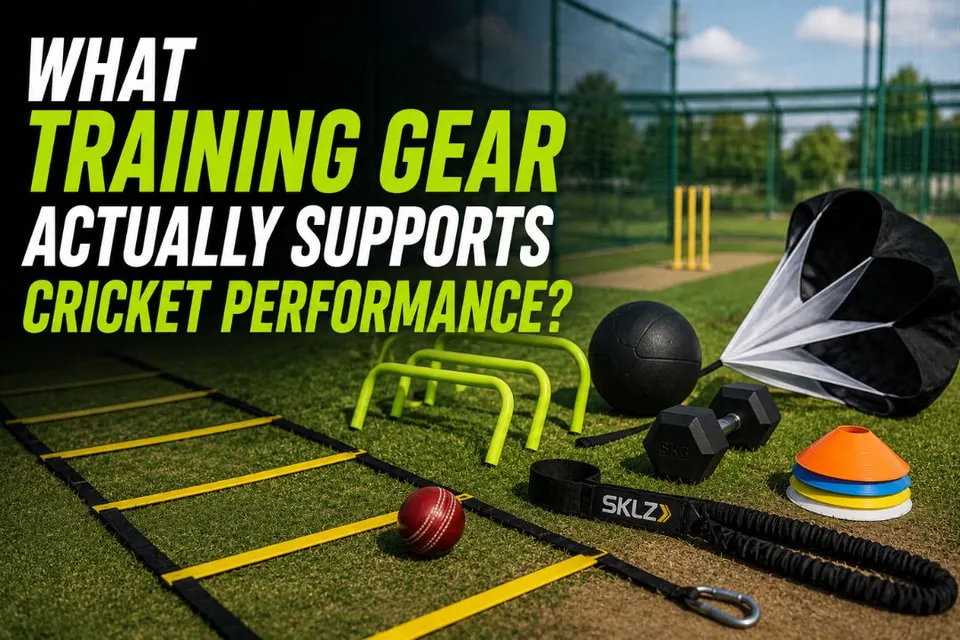
Bowling machines. The single most transformative piece of batting training equipment available, offering consistent line, length, and pace repetition that even a dedicated throw-down partner can't match over an extended session. Entry-level machines suitable for club-level training start in a reasonable price range, while more advanced machines offering spin variation and higher speed ranges cost significantly more.
Rebounder nets. A stretched net that returns a ball when struck, allowing solo practice of specific shots without needing a partner to feed balls. Genuinely useful for repetition-based technique work, though less realistic than facing actual bowling for reading line, length, and variation.
Weighted training bats. Slightly heavier than a normal match bat, used for a limited portion of practice to build forearm and wrist strength specific to the batting action. Should be used in moderation — excessive use can actually disrupt normal bat swing timing if overdone.
Stump-to-stump throw-down setups. A simple, effective tool for solo or paired practice, allowing controlled repetition of specific deliveries without requiring a full bowling machine investment.
Run-up markers and cones. Inexpensive but genuinely useful for grooving a consistent run-up rhythm — inconsistent run-up length is a surprisingly common cause of erratic line and length at club level, and visual markers help correct this systematically.
Target mats or zone markers placed on a length, used to give bowlers immediate visual feedback on where deliveries are actually landing relative to their intended target — a simple but effective tool for improving line and length consistency.
Resistance bands for shoulder and rotator cuff conditioning. While not cricket-specific equipment, these directly support the repetitive shoulder rotation demands of a bowling action, and are genuinely valuable for injury prevention alongside skill development.
Reaction/reflex balls. Irregularly shaped balls that bounce unpredictably, used to sharpen hand-eye coordination and reflex speed for close catching positions — a genuinely useful, low-cost training tool.
Sliding/diving practice mats. For players working on close-in fielding or wicketkeeping, a dedicated practice surface reduces injury risk while allowing repeated practice of diving stops and catches.
Throw-down and catching cradles. Simple angled surfaces that return a thrown ball unpredictably, useful for repetitive slip- and close-catching practice without needing a training partner for every repetition.
Under ₹2,000: Focus on cones, target mats, resistance bands, and a basic reaction ball — genuinely useful, low-cost tools that address specific technical elements (run-up consistency, shoulder conditioning, reflexes) without a major investment.
₹2,000–₹10,000: A rebounder net or a basic stump-to-stump throw-down setup becomes accessible at this range, offering meaningfully more batting repetition than solo practice without a partner.
₹10,000+: Entry-level bowling machines enter the picture at this budget tier — the single highest-impact piece of equipment for serious batting development, assuming consistent, structured use rather than occasional casual sessions.
If your weakness is technique against pace: A bowling machine set to consistent pace and length offers the most direct, repeatable training benefit — far more volume than most training partners can realistically provide over a session.
If your weakness is footwork and shot selection: A rebounder net combined with cone-marked target zones allows repetitive practice of specific shot types with immediate visual feedback.
If your weakness is bowling consistency: Run-up markers combined with target zone mats address the two most common sources of inconsistency — run-up rhythm and length control — directly and affordably.
If your weakness is reflex catching: A reaction ball is a small, inexpensive addition that genuinely sharpens the specific hand-eye coordination needed for close catching positions.
● Buy equipment to address a specific, identified weakness, not speculatively — training gear only helps if it's used with a clear purpose and consistent structure, not left unused after a few sessions.
● A bowling machine is a serious investment — verify space and setup requirements before buying. Most machines need a reasonable practice area (net or open ground) and consistent power access if electric, which isn't available to every player.
● Combine equipment-based training with actual match practice. Training aids build specific technical repetition, but reading live bowling variation and match-pressure decision-making still require genuine game time.
● Involve a coach when possible, even for equipment-based solo training — technical drills without feedback can occasionally reinforce incorrect habits if not periodically checked against sound technique. Pair this with the basics covered in our cricket equipment essentials guide so training gear complements the rest of your kit rather than sitting apart from it.
Skill Focus | Recommended Equipment | Approx. Budget |
Batting against pace/consistency | Bowling machine | ₹10,000+ |
Batting shot repetition, solo practice | Rebounder net | ₹2,000–₹8,000 |
Bowling run-up and rhythm | Cones and run-up markers | Under ₹1,000 |
Bowling line/length consistency | Target zone mats | ₹500–₹2,000 |
Reflex/close catching | Reaction balls | Under ₹500 |
Shoulder conditioning (bowlers) | Resistance bands | Under ₹500 |
Training gear genuinely accelerates cricket skill development — but only when it's matched to a specific technical weakness and used with consistent structure, not bought speculatively and left unused. Start with affordable, targeted tools like cones, target mats, and reaction balls to address specific run-up, length, or reflex issues, and consider a bowling machine or rebounder net once you're ready to invest in higher-volume, repeatable batting practice. The right equipment doesn't replace match play or coaching — it multiplies the value of both by giving you focused repetition on exactly what you need to improve.
Explore cricket training equipment and accessories at SportsGear24x7 — cones, reaction balls, and training aids to support every stage of your development.
Q1. Is a bowling machine worth buying for club-level cricketers?
Yes, if used consistently — a bowling machine offers far more repeatable, high-volume practice against consistent pace and length than most training partners can realistically provide, making it one of the highest-impact investments for serious batting development.
Q2. What's the cheapest way to start improving cricket skills with equipment?
Cones for run-up consistency, target zone mats for bowling length, and a basic reaction ball for reflex catching together cost under ₹2,000 and address genuinely common technical weaknesses at club level.
Q3. Can training equipment replace match practice?
No — training equipment builds specific technical repetition and muscle memory, but reading live bowling variation, game pressure, and match-situation decision-making still require genuine match experience.
Q4. What training gear helps bowlers most?
Run-up markers and target zone mats address the two most common sources of bowling inconsistency — rhythm and length control — while resistance bands support the shoulder conditioning needed to sustain a repetitive bowling action safely.
Q5. How much space do I need for a bowling machine?
Most bowling machines require a reasonably sized net or open practice area with enough length for realistic delivery distance, plus safe space behind and around the setup — verify your available practice space before investing, particularly for electric models needing power access.
The SportsGear24x7 Editorial Team is a group of passionate cricket enthusiasts and equipment specialists based in New Delhi, India. With over a decade of experience in the cricket gear industry, our team has helped thousands of players — from beginners to state-level competitors — find the right equipment for their game. Every article we publish is backed by real product knowledge, on-ground player feedback, and deep understanding of the Indian cricket ecosystem.