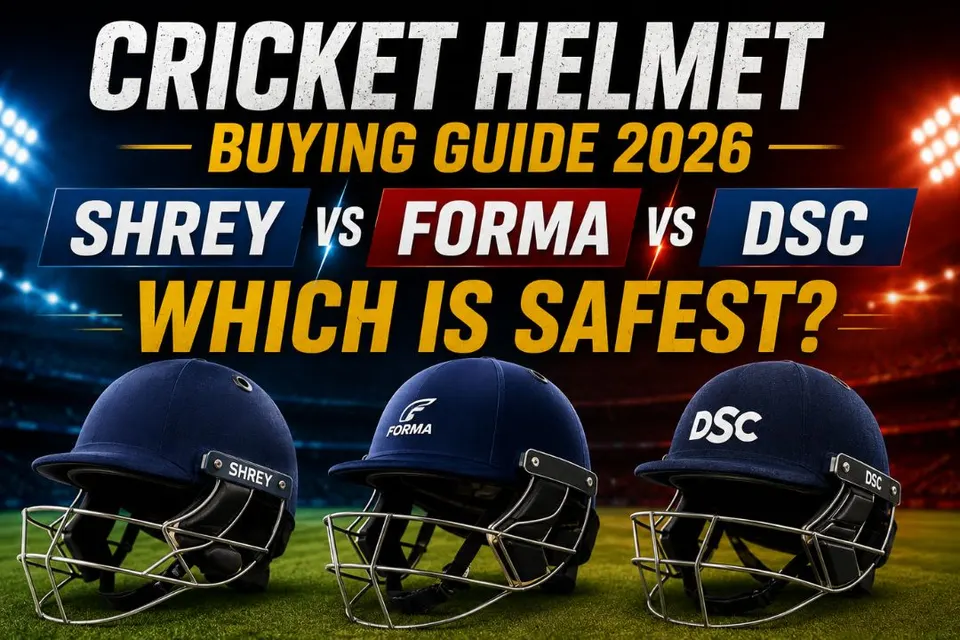
Cricket Helmet Buying Guide 2026: Shrey vs Forma vs DSC
Updated 11 min read

A cricket helmet for competitive play should be certified to BS 7928:2013+A1:2019, the current British Standard. The 2019 amendment added neck-protector and facial-contact projectile tests that the 2013 version never covered. Certification attaches to individual models, not to brands — so check the specific helmet you are buying, not the badge on the box.
BS 7928:2013 on its own is withdrawn. Look for the +A1:2019 amendment. If a listing does not say which version, ask before you pay.
The 2019 amendment added two tests that matter: a neck-protector specification, and a facial-contact projectile test for when the grille is pushed back towards the face.
A brand’s certification does not cover its whole range. Professional models usually carry more paperwork than budget club models from the same maker.
ISO 9001 is not a safety standard. It certifies factory quality management and tells you nothing about impact protection.
Size by head circumference, not by age. Measure just above the ears.
Replace after any serious impact, or every three to five years — the foam degrades without visible damage.
A cricket helmet sold for competitive play should be certified to BS 7928:2013+A1:2019. The England and Wales Cricket Board mandates this version, it is recognised by the International Cricket Council, and it is compulsory for all under-18 players in competitive cricket in the UK. It is the benchmark serious Indian clubs and academies increasingly ask for too.
The original BS 7928:2013 is withdrawn. It was superseded, not merely updated, and the difference is substantive.
The 2019 amendment added two things the 2013 standard never assessed:
A neck-protector specification. Before 2019 there was no standard governing the clip-on neck guards now common behind the helmet.
A facial-contact projectile test. This tests what happens when a ball strikes the grille hard enough to push it back towards the face. A grille can stop a ball passing through and still injure the wearer by deforming inward. The 2013 standard did not test for it.
That second test is the reason to care about the version number. It is not administrative housekeeping; it covers a specific injury mechanism that cricket learned about the hard way.
If a product listing cites “BS 7928” with no version, or cites 2013 alone, ask the seller which version that model was certified against. A seller who cannot answer that is not one to buy head protection from.
Not every mark on a helmet box means the same thing, and two of the most common are not impact standards at all. Ranked by what they tell you about protection:
Mark | What it covers | Weight for a buyer |
|---|---|---|
BS 7928:2013+A1:2019 with BSI Kitemark | The current British Standard, independently tested and audited by BSI rather than self-declared | Strongest signal available |
BS 7928:2013+A1:2019 | The current standard, including the neck-protector and facial-contact projectile tests | Strong |
BS 7928:2013 | The superseded version. Certified, but never assessed for neck protection or facial contact | Partial — ask which version current stock carries |
(EU) 2016/425 · CE · UKCA · UKNI | General personal protective equipment conformity for Europe and the UK | Supporting, not cricket-specific |
ICC compliance | Tested for professional match use against specified ball weights | Useful, especially where junior ball weights are stated |
ISO 9001:2015 | Manufacturing quality management | No safety weight |
The last row is worth pausing on. ISO 9001 certifies that a factory documents and controls its processes consistently. It is a genuine credential and it says nothing whatsoever about whether a helmet stops a cricket ball. It appears on helmet marketing often enough that it is worth knowing what it is not.
The distinction between a Kitemark and a plain standards claim is also real. A Kitemark means BSI tested the product and audits the factory. Without it, a certification claim may be the manufacturer’s own declaration. Both can be honest. Only one is independently checked.
This is the most important thing on this page. A brand’s certification does not automatically apply to every helmet it sells. Manufacturers certify individual models, and professional lines almost always carry more paperwork than budget club ranges.
DSC is the clearest illustration. Professional models such as the Empra SS and Empra Titanium are fully BSI approved and certified. Basic recreational club guards may be built from high-impact ABS without the full professional BSI certification behind them. Both are sold as DSC helmets. In safety terms they are not the same product.
Forma makes the same point from the other direction. Its Pro Axis is certified to the current BS 7928:2013+A1:2019, while the data we hold for other Forma models shows the 2013 version. One brand, two standards, depending which helmet you pick up.
So do not buy on the badge.
Check the certification on the specific model, and if the listing does not state it, ask before paying. This is one of the things we can check for you — if you tell us the model, we will tell you what certification it carries, and say so plainly when we cannot confirm it.
Shrey | Forma | DSC | |
|---|---|---|---|
BS 7928:2013+A1:2019 | Yes, across the main lines | Yes on the Pro Axis. Other models: 2013-version data only | Yes, on professional models |
BSI Kitemark | Not stated | Not stated | Yes |
(EU) 2016/425 / PPE | Yes | Yes (CE, UKCA, UKNI) | Yes, senior models |
ICC compliance | Yes — tested with both 4¾ oz junior and 5½ oz men’s balls | Not stated | Used at international level |
Other credentials | — | Australian Standard; ISO 9001:2015 (manufacturing, not impact) | — |
Range covered | Masterclass, Pro Guard, Classic, Koroyd | Pro Axis confirmed on the current standard; other models not confirmed | Professional models only — budget club guards may differ |
Reading this table. Shrey and DSC’s professional models both sit on the current standard. DSC’s professional range adds the BSI Kitemark, meaning independent testing rather than self-declaration — the strongest single mark here. Shrey is the only one of the three whose ICC testing explicitly covers the 4¾ oz junior ball as well as the men’s 5½ oz, which matters directly if you are buying for a junior player.
Forma is the clearest illustration of why this page is organised around models rather than brands. The Forma Pro Axis is certified to BS 7928:2013+A1:2019 — the current standard, including both tests added in 2019. For Forma’s other models, the certification data available to us still shows the 2013 version.
So the same maker sells helmets on both sides of that line. Neither is uncertified, and Forma holds British, European, UK and Australian conformity marks across its range. But if the 2019 tests matter to you, the Pro Axis is the Forma model we can confirm. For any other model, ask which version it carries before you buy.
Certification data verified from manufacturer sources, September 2026. Standards and model ranges change — check the current product listing.
Measure the circumference of your head just above the ears, keeping the tape level. Match that measurement to the size chart. Do not size by age — head circumference varies widely between players of the same age, and a helmet that moves is a helmet that has already failed.
Size | Head circumference |
|---|---|
S | 54–56 cm |
M | 57–58 cm |
L | 59–60 cm |
XL | 61–62 cm |
A correctly fitted helmet sits level, covers the forehead, and does not rock forward or sideways when you shake your head. There should be no gap between the grille and the peak large enough for a ball to pass through. That gap is regulated by the standard, and it changes when the grille is adjusted.
For a junior, resist buying a size up to grow into. A loose helmet shifts on impact and the grille gap opens. Buy to fit now.
Grille choice is mostly a trade-off between weight and durability, not between safe and unsafe. Any grille on a properly certified helmet has passed the same tests. What changes is neck fatigue over a long innings, how the grille behaves after a hard impact, and how much it costs to replace.
Grille | Weight | After impact | Typically suits |
|---|---|---|---|
Steel | Heaviest | Holds shape well; easy to source replacements | Club and school cricket, budget-conscious buyers |
Titanium | Lightest | Same structural role at lower weight | Long innings, players facing pace, anyone who feels neck fatigue |
Hybrid (MST and similar) | Middle | Bar placement optimised for sightlines | Players who want lighter weight without full titanium cost |
Titanium’s advantage is real but it is comfort, not protection. A certified steel grille protects you. It just weighs more, and after two hours at the crease that matters more than it sounds.
Be cautious with any claim that one grille design is “strongest” without a test result behind it. Marketing language around grille systems runs well ahead of published testing. The certification on the helmet is the claim that has been checked.
Yes, if you face pace. The neck protector is the specific addition the 2019 amendment brought into the standard, which tells you how seriously the governing bodies now take that injury mechanism. Many clubs and academies require one, and it is mandatory in some competitive age-group cricket.
Buy a neck guard designed for your helmet model. A generic clip-on can sit at the wrong angle or work loose, and a guard that shifts during play protects less than one that is matched to the shell.
Replace after any serious impact, and otherwise every three to five years of regular use. The internal foam compresses and degrades over time, losing shock absorption without any visible sign. A helmet that looks fine can have stopped performing.
Replace immediately if you see cracks in the shell, a deformed or previously struck grille, degraded or crumbling padding, or a fit that has loosened and cannot be adjusted back.
No helmet makes a player safe. Certified head protection reduces the risk of serious injury; it does not remove it, and no helmet should be worn as though it does.
On the evidence available, DSC’s professional models carry the strongest single credential — the current standard with the BSI Kitemark, meaning independently tested rather than self-declared. Shrey certifies the current standard across its main lines, not only its premium range. It is also the only one of the three to state ICC testing against the junior ball weight, which makes it a sound default for a growing player.
Forma’s Pro Axis is certified to the current standard, while the data we hold for its other models shows the 2013 version. That makes Forma the sharpest example of the point this whole page is making: the brand is not the unit of safety, the model is.
But “which brand” is the wrong question. Certification attaches to models, not badges. A professional model from any of these three will out-certify a budget model from the same maker.
Buy the model whose certification you can read, not the brand you recognise. If you cannot read it, ask — and if nobody will tell you, that is your answer.
No brand is safest across its whole range, because certification applies per model. DSC’s professional models carry the BSI Kitemark, Shrey certifies the current standard across its main lines, and Forma’s Pro Axis meets it while other Forma models show 2013 data. Compare models.
Measure the circumference of your head just above your ears, keeping the tape level. Adult helmets run S (54–56 cm), M (57–58 cm), L (59–60 cm) and XL (61–62 cm). Size by measurement, never by age, and never buy large for a junior to grow into.
The 2019 amendment added a neck-protector specification and a facial-contact projectile test, which assesses what happens when a ball pushes the grille back towards the face. BS 7928:2013 alone is withdrawn. Ask which version a helmet was certified against before buying.
No. On a properly certified helmet both grilles have passed the same tests. Titanium is lighter, which reduces neck fatigue during long innings, and it usually costs more. Choose on comfort and budget, not on a safety difference that certification does not support.
Not if you face pace. The neck protector was brought into the British Standard by the 2019 amendment, and many clubs and age-group competitions now require one. Buy a guard matched to your helmet model, since a loose generic guard can sit at the wrong angle.
Replace after any serious impact, or every three to five years of regular use. The internal foam loses its shock-absorbing properties over time with no visible sign of damage, so a helmet that still looks sound may no longer protect properly.
No. ISO 9001:2015 certifies a manufacturer’s quality management system — how consistently the factory documents and controls its processes. It is a real credential, but it assesses nothing about impact protection. Look for BS 7928:2013+A1:2019 instead.
Related
The SportsGear24x7 Editorial Team is a group of passionate cricket enthusiasts and equipment specialists based in New Delhi, India. With over a decade of experience in the cricket gear industry, our team has helped thousands of players — from beginners to state-level competitors — find the right equipment for their game. Every article we publish is backed by real product knowledge, on-ground player feedback, and deep understanding of the Indian cricket ecosystem.