
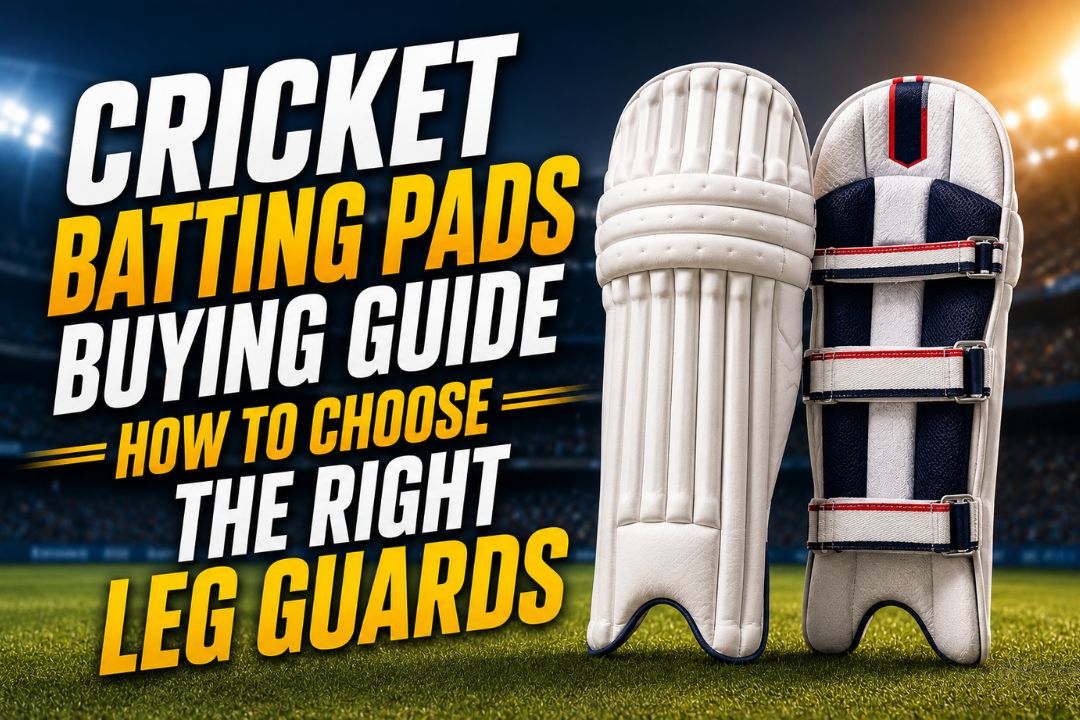
Cricket Batting Pads Buying Guide — How to Choose the Right Leg Guards
3 min read
On this page
Introduction
Choosing the right cricket batting pads is not just about covering your legs — it is about giving yourself the confidence to play forward without fear. In this guide, we explain what makes a good pair of cricket leg guards, how to measure yourself for the right fit, and which brands to consider for your level and budget.
What Are Cricket Batting Pads Made Of?
Outer Shell
Made from white PVC or leather, the outer shell provides the first layer of impact resistance. Premium pads use reinforced PVC with a moulded knee roll that does not shift during movement.
Internal Padding
High-density foam is layered inside the pad. Better pads use multi-density foam — harder at the knee and cane-protected at the shin, softer at the inner leg.
Strapping System
Pads are held in place by 2–3 velcro straps. Good strapping keeps the pad aligned even during quick running, diving, and extreme batting positions.
How to Measure for Cricket Batting Pads
• Sit on a chair with your knee bent at 90 degrees
• Measure from the centre of your kneecap to the top of your foot (this is your pad length)
• Measure the circumference of your calf at its widest point (this determines pad width)
Size | Pad Length |
|---|---|
Junior Small | Up to 35 cm |
Junior Large | 35–40 cm |
Adult Small | 40–44 cm |
Adult Medium | 44–47 cm |
Adult Large | 47+ cm |
If you are between sizes, size up — pads that are too short leave your shin exposed.
Best Cricket Batting Pads in India 2026
SG RP Ecolite and SG RP Club
SG produces consistently well-rated cricket leg guards for club-level cricketers. The RP Ecolite features a high knee roll, reinforced cane protection, and three Velcro straps. Price range: ₹700–₹2,000.
SG Shield and Optipro
For competitive players, the Shield features a moulded knee roll with additional thigh flap stitching. The Optipro uses premium materials and is used by state-level domestic cricketers. Price range: ₹2,500–₹5,000.
DSC Condor Motion and DSC Intense Series
The most popular choices for school and beginner cricketers. If you are buying cricket leg guards for beginners, DSC offers the best combination of protection and affordability at the entry level. Price range: ₹500–₹1,500.
SS Ton Pro Series
The Ton Pro 10 features extra-firm knee roll, triple-strap system, and wide face for excellent coverage. Among the most protective cricket batting pads at the mid-to-premium level. Price range: ₹1,800–₹4,000.
Practical Tips for Cricket Batting Pads
• Dry your pads after every session — moisture weakens internal foam and degrades strap velcro
• Store pads vertically — laying them flat compresses the foam over time
• Check strap integrity before each match — frayed velcro can cause pad-slip at critical moments
• Replace pads when foam flattening is visible — compressed foam no longer absorbs impact correctly
Conclusion
The right cricket batting pads let you play forward with confidence, absorb the impact of fast deliveries safely, and perform without distraction from ill-fitting equipment.
Frequently asked questions
What size batting pads do I need?
Measure from your kneecap centre to the top of your foot. Categories are: Junior Small (up to 35 cm), Junior Large (35–40 cm), Adult Small (40–44 cm), Medium (44–47 cm), Large (47+ cm). When in doubt, size up.
Which brand makes the best cricket batting pads in India?
SG and SS produce the best overall batting pads for club and competitive cricket. DSC is the top choice for beginners and school players.
How long do cricket batting pads last?
Well-maintained cricket pads last 2–3 seasons of regular play. Signs of replacement time include visible foam compression, cracked knee rolls, and non-functioning strap velcro.
Can I wash cricket batting pads?
Wipe pads down with a damp cloth after each session. Do not machine wash — this degrades the foam padding and outer shell rapidly. Allow to air dry naturally before storing.
What is the difference between batting pads and wicketkeeping pads?
Batting pads are larger with full shin and knee coverage. Wicketkeeping leg guards are shorter and slimmer to allow the crouching position required behind the stumps.