

Pickleball's fastest growing sport status in India is no longer just a statement it's visible on courts from Mumbai to Bangalore, in residential societies, sports clubs, and now dedicated pickleball academies.
But the paddle market has exploded alongside the sport, and choosing the wrong paddle for your skill level is one of the biggest mistakes new and developing players make. A beginner using an advanced player's stiff carbon fibre paddle will struggle to control the ball. An experienced player using an entry-level fibreglass paddle will feel like they're hitting with a frying pan.
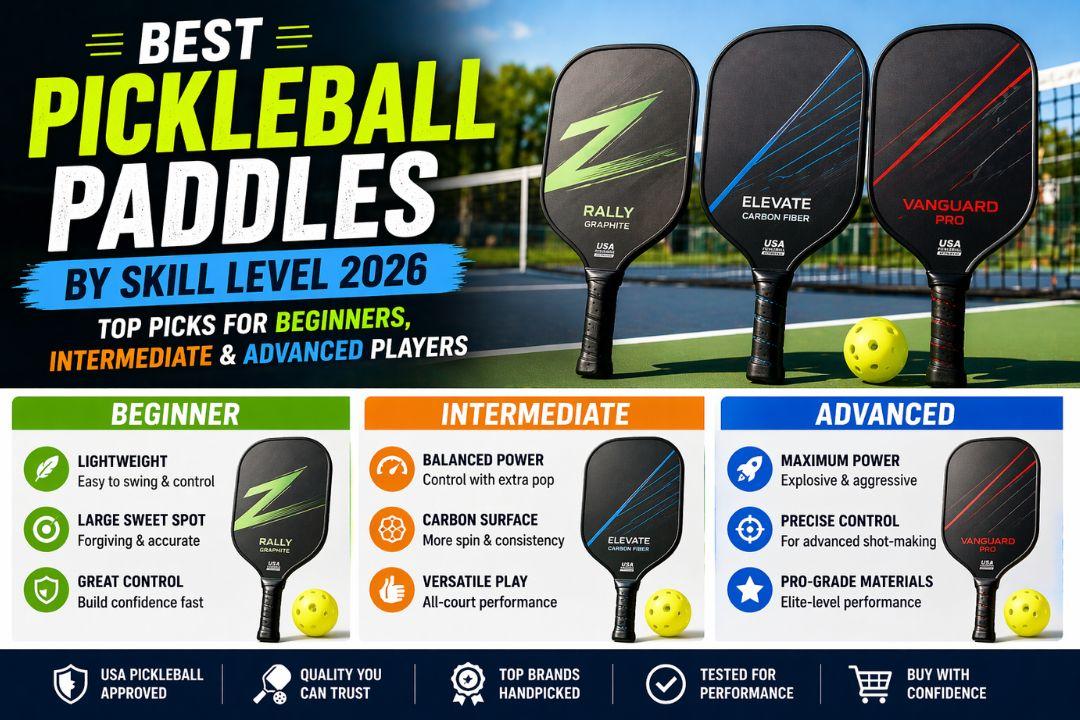
This guide matches the best pickleball paddles to each skill level for 2026 with specific recommendations, key specs explained, and a buying decision framework that saves you from wasting money on the wrong equipment.
Before recommendations by level, understand these five specs that determine how a paddle performs:
Surface Material: The paddle face. Fibreglass = more power and flex. Carbon fibre = more control and spin. Raw carbon = maximum spin, less power. This single factor matters most.
Core Material: What's inside the paddle. Polymer (plastic) honeycomb = soft, controlled, quiet. Nomex = harder, more power, louder. Nearly all modern paddles use polymer cores.
Core Thickness: 13mm–16mm is the most common range. Thicker cores = more control and "dwell time." Thinner cores = more power but less forgiveness. Most players benefit from 16mm.
Weight: 7.0–8.5 oz (200–240g) is the standard range. Lighter = faster swing and easier on elbows. Heavier = more power on drives and blocks. Beginners should start mid-weight.
Grip Circumference: 4 inches (small grip) to 4.5 inches (large grip). If your fingers overlap your palm when gripping, the grip is too small. Correct grip size prevents elbow issues.
As a beginner, you need three things: forgiveness on mishits, a comfortable weight that doesn't fatigue your arm, and a price that doesn't hurt if you realise pickleball isn't for you after three weeks.
Surface: Fibreglass (power + forgiveness over pure control)
Core: Polymer, 16mm thickness
Weight: 7.5–8.0 oz (215–230g)
Price Range: ₹2,000–₹5,000
1. Onix Graphite Z5 (Beginner-Friendly Classic) The Z5 has been one of the most recommended beginner paddles globally for years. Its widebody shape creates a larger sweet spot, the graphite face offers controlled power, and the weight is forgiving on the arm. Widely available in India through sports retailers.
2. Selkirk Latitude (Best Value Beginner) Polymer core, fibreglass face, comfortable grip. Delivers consistent performance across rallies. Slightly lighter than the Z5, which suits players who are building their game around finesse rather than power.
3. Local Brand Fibreglass Paddles (₹2,000–₹3,500) For Indian beginners who aren't ready to invest ₹5,000+ in their first paddle, several quality local-manufacture fibreglass paddles now perform adequately for rally-based beginner play. Look for polymer core, 16mm thickness, and a face that doesn't feel hollow on impact.
Intermediate players have developed consistent dinking, know their third-shot drop, and are starting to play competitively at club level. The paddle needs to grow with the game — more control at the kitchen line, enough power for drives, and spin capability for serving.
Surface: Fibreglass or entry-level carbon fibre
Core: Polymer, 14mm–16mm thickness
Weight: 7.8–8.3 oz (220–235g)
Price Range: ₹5,000–₹10,000
1. Paddletek Bantam EX-L Pro (Best All-Round Intermediate) The Bantam EX-L Pro sits perfectly in the intermediate sweet spot. Fibreglass face delivers power on groundstrokes while the 16mm polymer core provides enough dwell for controlled dinks. Comfortable grip, excellent balance, and durability that outlasts many paddles in this category.
2. Engage Pursuit MX 6.0 (Best for Bangers Becoming Controllers) If you've been a power hitter who now wants to develop a softer game, the MX 6.0's unique skin texture generates spin while the medium-thick core smooths out your dink game. An excellent transition paddle.
3. ONIX Evoke Premier (Best Budget Intermediate) For players ready to step up from beginner paddles without spending ₹8,000+, the Evoke Premier offers composite face construction and balanced weight at an accessible price. Solid all-round performance for club-level intermediate play.
Advanced players know their game inside out. They're playing tournaments, working specific tactics, and choosing paddles that match a deliberate playing style rather than covering general bases.
Surface: Carbon fibre or raw carbon (T700 or better)
Core: Polymer, 13mm–16mm (thinner for power players, thicker for control players)
Weight: 7.5–8.5 oz depending on play style
Price Range: ₹10,000–₹20,000+
1. Joola Hyperion CFS 16 (Best for Control-Dominant Advanced Players) The Hyperion CFS uses Joola's Carbon Friction Surface — a raw carbon face with texture that generates extraordinary spin. The 16mm core provides exceptional dwell time at the kitchen, making this a devastatingly effective NVZ (non-volley zone) paddle. Used by several top-ranked recreational and competitive players.
2. Selkirk Vanguard Power Air Invikta (Best Power Paddle for Advanced) If your game is built on pace — hard drives, aggressive returns, powerful serves — the Invikta's elongated shape and stiffer carbon face maximises reach and power transfer. The extended length gives a longer lever without significant weight increase.
3. Franklin Signature Series Pro (Best Tournament Paddle) Built for tournament play. Carbon fibre face, optimised core density, and a precision edge guard that survives the physical demands of competitive play. The Franklin tour line consistently earns high marks from tournament players who prioritise durability alongside performance.
Level | Surface | Core Thickness | Weight | Budget |
|---|---|---|---|---|
Beginner | Fibreglass | 16mm | 7.5–8.0 oz | ₹2,000–₹5,000 |
Intermediate | Fibreglass / Carbon | 14–16mm | 7.8–8.3 oz | ₹5,000–₹10,000 |
Advanced | Carbon / Raw Carbon | 13–16mm | 7.5–8.5 oz | ₹10,000–₹20,000+ |
Demo before you buy at advanced level. Many pickleball clubs now allow paddle testing. Use this opportunity before spending ₹15,000 on a tournament paddle.
Don't skip levels. Using an advanced paddle as a beginner builds bad habits — the low forgiveness punishes mishits that beginners make constantly.
Replace overgrips regularly. A fresh overgrip on a mid-range paddle outperforms a worn overgrip on an expensive one. Replace every 10-15 hours of play.
Check USAPA approval for tournaments. If you plan to play formal tournaments, verify your paddle is on the USAPA approved paddle list before purchasing.
Don't chase trends. Carbon texture paddles are currently the trend. But if your game is built on power and driving rather than spin, a quality fibreglass paddle at half the price may serve you better.
The best pickleball paddle isn't the most expensive one — it's the one matched to your current skill level and playing style. Beginners need forgiveness and comfort. Intermediate players need versatility and improving control. Advanced players need precision tools that match specific tactical games.
Browse SportsGear24x7's complete pickleball paddle range — from beginner-friendly fibreglass options to advanced carbon paddles — all available with fast delivery across India.
Q1: What is the best pickleball paddle for beginners in India 2026? For Indian beginners, look for a fibreglass face paddle with a 16mm polymer core weighing around 7.5-8.0 oz. The Onix Graphite Z5 and Selkirk Latitude are popular globally; locally available fibreglass paddles in the ₹2,500–₹4,000 range also perform well for beginner play.
Q2: What pickleball paddle do advanced players use? Advanced players typically use carbon fibre or raw carbon face paddles from brands like Joola, Selkirk, Ben Johns Signature, and Franklin. These offer maximum spin generation and control at the kitchen line.
Q3: What is the difference between fibreglass and carbon fibre pickleball paddles? Fibreglass paddles flex more on contact, generating power and a larger sweet spot — ideal for beginners. Carbon fibre paddles are stiffer, generating more spin and control but less power. Advanced players generally prefer carbon for precise kitchen play.
Q4: How much should I spend on a pickleball paddle in India 2026? Beginners: ₹2,000–₹5,000. Intermediate players: ₹5,000–₹10,000. Advanced/tournament players: ₹10,000–₹20,000+.
Q5: How often should you replace a pickleball paddle? With regular play (3-4 sessions per week), intermediate paddles typically last 1-2 years before the face surface degrades. Advanced players who play tournament-level often replace paddles annually. Signs of replacement: surface feels dead, edge guard cracking, delamination of the face.
The SportsGear24x7 Editorial Team is a group of multi-sport gear specialists and equipment enthusiasts based in New Delhi, India. With 10+ years of experience across cricket, tennis, badminton, football, and more — our team has helped thousands of players at every level find the right gear for their game. Every article we publish is backed by genuine product expertise, real player feedback, and a deep passion for sport.