Best Pickleball Balls for Indoor vs Outdoor Play: Complete Guide
4 min read


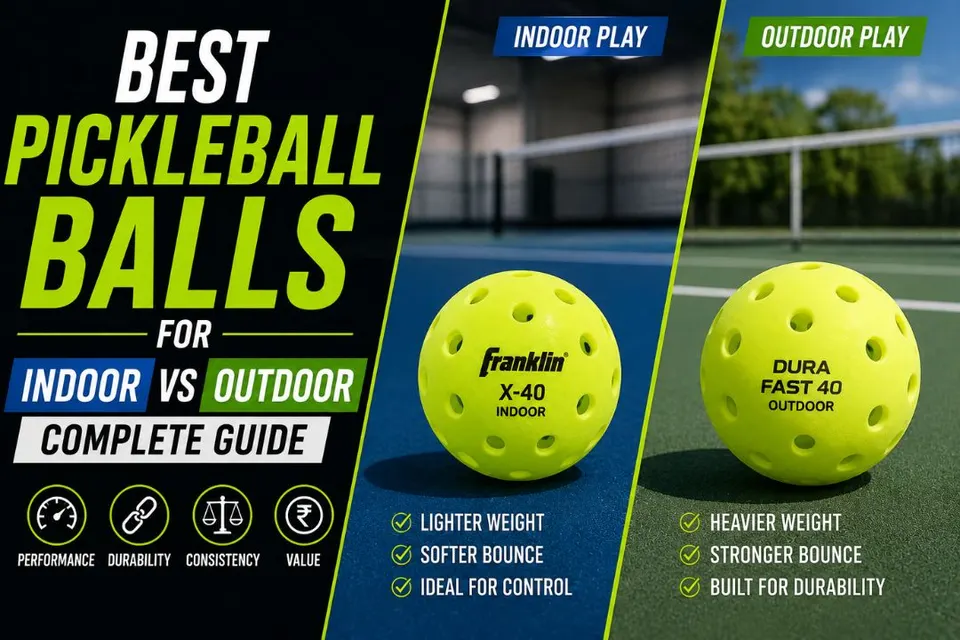
New pickleball players often assume a ball is a ball — until they play with the wrong type and wonder why their shots feel unpredictable, their smashes lack pace, or the ball cracks after a handful of sessions. Indoor and outdoor pickleballs are built differently for genuinely different playing conditions, and choosing correctly changes how the game actually feels.
Indoor and outdoor pickleball courts present different challenges — wind resistance outdoors, different surface hardness, and different temperature ranges that affect plastic performance. A ball optimised for one environment performs poorly, or breaks down faster, in the other.
Feature | Indoor Ball | Outdoor Ball |
Hole count | Typically fewer, larger holes (around 26) | More, smaller holes (around 40) |
Weight | Slightly lighter | Slightly heavier, to resist wind |
Material hardness | Softer plastic | Harder, more durable plastic |
Bounce | Lower, more controlled | Higher, more consistent in open air |
Sound | Quieter — better for shared indoor facilities | Louder on contact |
The core engineering logic: outdoor balls need extra weight and durability to resist wind and survive contact with rougher outdoor court surfaces, while indoor balls prioritise a controlled, lower bounce suited to smooth indoor flooring and quieter play for shared facilities.
• Outdoor ball used indoors: Bounces unpredictably higher and louder on smooth indoor courts, making shot control noticeably harder to judge.
• Indoor ball used outdoors: Wind affects the lighter ball more significantly, and the softer plastic wears out much faster against rough outdoor surfaces like concrete or textured acrylic.
If you regularly move between environments — say, weekday indoor sessions and weekend outdoor games — it’s worth keeping both ball types on hand rather than compromising with a single “do it all” ball.
1. Hole pattern matched to environment. Fewer, larger holes for indoor use; more, smaller holes for outdoor use — this is the single biggest indicator of which environment a ball is built for.
2. Material durability. Outdoor balls in particular need to withstand rougher surfaces and temperature swings without cracking prematurely.
3. Consistent weight and roundness. Cheap, poorly manufactured balls can have inconsistent weight distribution, which affects flight and bounce predictability — a real problem for players working on shot precision.
4. Colour visibility. Bright, high-visibility colours (commonly yellow or optic green) make tracking the ball easier, particularly outdoors against varied backgrounds.
• Beginners learning the game: Start with whichever ball type matches where you’ll play most often — consistency in practice conditions accelerates learning.
• Club and league players: Keep both indoor and outdoor balls on hand, since competitive play often moves between facility types across a season.
• Casual backyard players: An outdoor-specific ball is almost always the right call, given the added durability against rough surfaces and wind resistance.
SportsGear24x7 stocks Synco pickleball equipment, a brand offering both indoor and outdoor ball options designed to meet performance standards for beginners through advanced players. Browse the full range in our Pickleball collection and explore Synco’s complete pickleball range for paddles, balls, and nets.
• Warm up with the specific ball type you’ll compete with, not a different one, since your read on bounce and pace needs to match match-day conditions.
• Rotate balls during long sessions. Even durable balls soften slightly with extended use — rotating in a fresh ball keeps practice conditions consistent.
• Store balls out of direct, prolonged sun exposure when not in use, as UV exposure gradually degrades plastic durability, particularly for outdoor balls stored outside between sessions.
• Inspect for cracks regularly. A cracked ball flies unpredictably and should be retired immediately, especially during competitive play.
Playing Situation | Recommended Ball |
Indoor court, smooth flooring | Indoor ball — softer, lower bounce |
Outdoor court, open air | Outdoor ball — harder, wind-resistant |
Mixed indoor/outdoor play | Keep both types on hand |
Beginner building consistency | Match ball to primary practice environment |
The difference between indoor and outdoor pickleballs isn’t marketing — it’s genuine engineering built around wind resistance, surface hardness, and bounce control. Matching the right ball to your playing environment makes your shots more predictable, extends the ball’s usable life, and simply makes the game feel right, whether you’re smashing at the net or working on a controlled dink.
Q: Can I use an outdoor pickleball indoors?
You can, but it will bounce higher and louder than an indoor-specific ball, and shot control becomes noticeably harder to judge on smooth indoor flooring.
Q: How many holes does an indoor pickleball have compared to an outdoor one?
Indoor balls typically have around 26 larger holes, while outdoor balls have around 40 smaller holes — this difference directly affects wind resistance and bounce characteristics.
Q: How often should pickleball balls be replaced?
Replace as soon as cracks appear or the ball noticeably loses its round shape — a damaged ball flies unpredictably and can affect both practice quality and safety during fast exchanges at the net.
Q: Is there a big price difference between indoor and outdoor balls?
Generally minimal — the main consideration should be matching the ball to your primary playing environment rather than price alone.
The SportsGear24x7 Editorial Team is a group of passionate cricket enthusiasts and equipment specialists based in New Delhi, India. With over a decade of experience in the cricket gear industry, our team has helped thousands of players — from beginners to state-level competitors — find the right equipment for their game. Every article we publish is backed by real product knowledge, on-ground player feedback, and deep understanding of the Indian cricket ecosystem.