1-Star vs 3-Star Table Tennis Balls Explained
Updated 5 min read


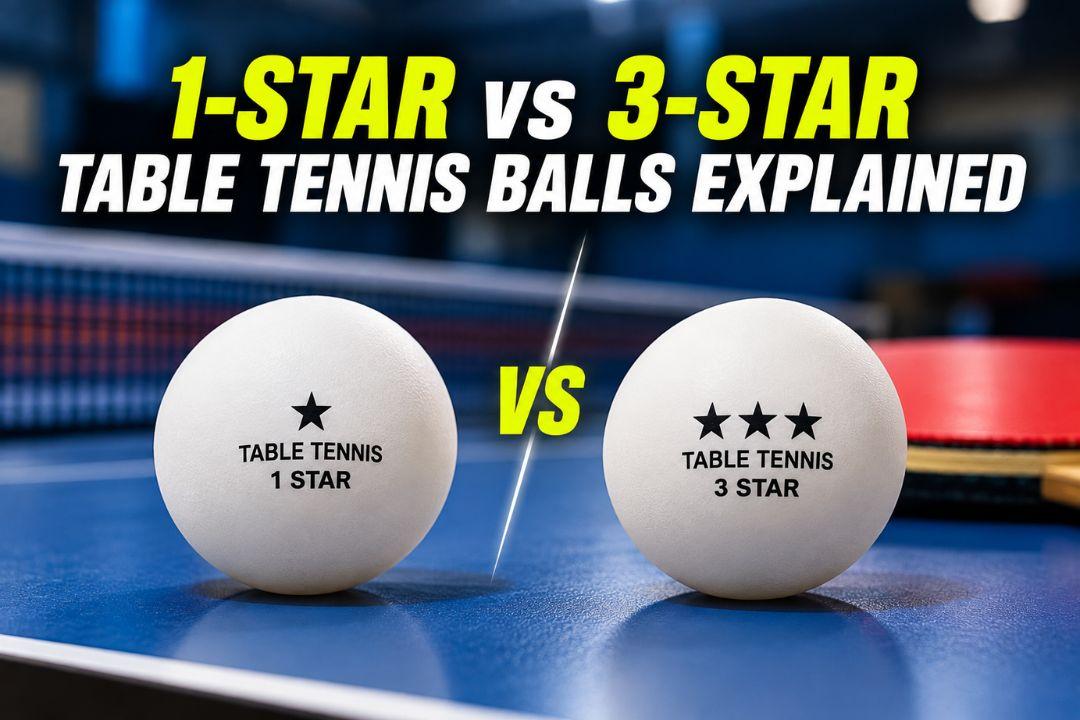
QUICK ANSWER 3-star balls are the tournament-grade standard — precisely round, consistently bouncing, and used in official competitive play, including ITTF-approved balls. 1-star balls, like the STAG Iconic, are built for practice and recreational play — slightly less precise in roundness and bounce consistency, but significantly more cost-effective for high-volume training where balls get lost, cracked, or worn out regularly. |
Most recreational players assume all table tennis balls are basically the same — round, white or orange, and that's it. In reality, star ratings reflect real, measurable differences in manufacturing precision: sphericity (how perfectly round the ball is), bounce consistency, and material uniformity. Using a mismatched ball for your purpose either wastes money (buying premium 3-star balls that get lost in casual garage sessions) or hurts your practice quality (training with inconsistent balls when you're trying to fine-tune spin and placement for competitive play).
Table tennis is a game of small margins — a millimeter of spin variation or an inconsistent bounce can be the difference between a return that clips the table and one that sails long. A ball with even minor imperfections in roundness will wobble unpredictably in flight, especially on serves with heavy spin, giving false feedback about your own technique. For players working seriously on spin control, footwork, and shot placement, training with inconsistent balls teaches your reflexes to compensate for the ball's flaws rather than sharpening your actual technique.
The STAG Iconic is built as a reliable practice-grade ball — a solid, durable 1-star option designed for the reality of regular training: balls that get smashed off the table, stepped on, and generally taking a beating during repetitive drills. While it won't match the precision manufacturing of a 3-star tournament ball, it offers consistent-enough bounce and flight for skill-building drills, multi-ball training, and casual or club-level recreational play, all at a price point that makes buying in bulk practical.
Why this matters for training economics: Serious players and coaches often go through dozens of balls per month during multi-ball feeding drills. Using premium 3-star balls for this volume of practice is financially impractical — the STAG Iconic's 1-star positioning solves exactly this problem, letting you train frequently without worrying about the cost of lost or damaged balls.
• Reserve 3-star balls for match simulation and serious spin work. When you're specifically training to read and generate spin for competitive play, ball consistency matters enough to justify the higher cost.
• Use 1-star balls for volume drills, multi-ball training, and warm-ups, where the sheer number of repetitions matters more than pinpoint ball consistency.
• Check for visible seams or asymmetry before a session — even within star ratings, individual balls can develop flat spots after enough impacts; retire any ball that visibly wobbles in flight.
• Store balls away from direct heat or sunlight — table tennis balls (particularly celluloid-based ones) can warp if left in a hot car or direct sun, affecting bounce regardless of star rating.
Star Rating | Best Use | Precision Level | Cost Efficiency |
3-Star | Tournaments, competitive matches, official/ITTF-level play | Highest — precise roundness & bounce | Lower (higher per-ball cost) |
1-Star | Practice, multi-ball drills, recreational/club play | Good, sufficient for training | Highest — ideal for bulk buying |
Unrated/novelty | Casual home/garage play only | Variable, not recommended for skill training | High volume, low precision |
Rule of thumb: Train in volume with 1-star balls like the STAG Iconic, and reserve a set of 3-star balls specifically for match-simulation practice and actual competitive play.
Picture a coach running a multi-ball feeding drill with a junior squad — feeding 50-plus balls per player, per session, focused purely on repetition of forehand topspin technique. Using 3-star balls for this would be financially unsustainable given how many balls end up in the net, under tables, or scuffed against walls during a beginner-heavy session. Switching to 1-star balls like the STAG Iconic for these high-volume drills keeps the cost per session manageable while still giving players enough bounce consistency to build correct technique. Then, in the final 20 minutes of the same session — when players move into live, competitive point-play — the coach swaps in 3-star balls specifically so players get accurate, tournament-realistic feedback on their shot placement and spin reads when it matters most.
Star rating isn't just marketing — it reflects real manufacturing precision that affects bounce consistency and flight accuracy. The STAG Iconic 1-star ball is the smart, cost-effective choice for the bulk of your practice time, letting you train frequently and confidently without burning through expensive tournament-grade balls. Save your 3-star balls for when precision truly counts: competitive matches and focused technical sessions.
1. What's the actual difference between 1-star and 3-star table tennis balls?
3-star balls are manufactured to higher precision standards for roundness and bounce consistency, making them suitable for competitive and tournament play, while 1-star balls are built for practice and recreational use at a more affordable price point.
2. Can I use 1-star balls for serious training?
Yes, 1-star balls like the STAG Iconic are excellent for volume-based drills, multi-ball training, and general skill-building, where the number of repetitions matters more than pinpoint bounce precision.
3. Are 3-star table tennis balls required for tournaments?
Most official and competitive tournaments require 3-star, often ITTF-approved balls, to ensure consistent play quality across all matches. Check your specific tournament's regulations for exact requirements.
4. How long do table tennis balls typically last?
This depends heavily on usage — a 1-star practice ball used in high-volume drills may need replacing within weeks, while a well-cared-for 3-star ball used only for careful match play can last considerably longer.
5. Do star ratings affect ball material (celluloid vs plastic)?
Star rating refers to precision and performance grade, not material directly, though premium 3-star balls often use more consistent, higher-quality material construction that also contributes to their improved play characteristics.
Stock up on reliable practice balls — shop the STAG Iconic 1-Star Table Tennis Ball at SportsGear24x7.
The SportsGear24x7 Editorial Team is a group of passionate cricket enthusiasts and equipment specialists based in New Delhi, India. With over a decade of experience in the cricket gear industry, our team has helped thousands of players — from beginners to state-level competitors — find the right equipment for their game. Every article we publish is backed by real product knowledge, on-ground player feedback, and deep understanding of the Indian cricket ecosystem.