How to Choose a Football in India 2026: Size, Material, Brand & Surface Complete Buying Guide
7 min read

A football is a football, right? You buy one, you play with it.
This is the thinking that leads players to buy a size 5 ball for a 7-year-old, a machine-stitched plastic shell for competitive club play, or an expensive PU match ball for concrete courtyard kickabouts that destroys it in three sessions.
The wrong football for the wrong context wastes money, hurts skill development, and in some cases — particularly for young players — causes the kind of impact injuries that the correct ball size would have prevented entirely.
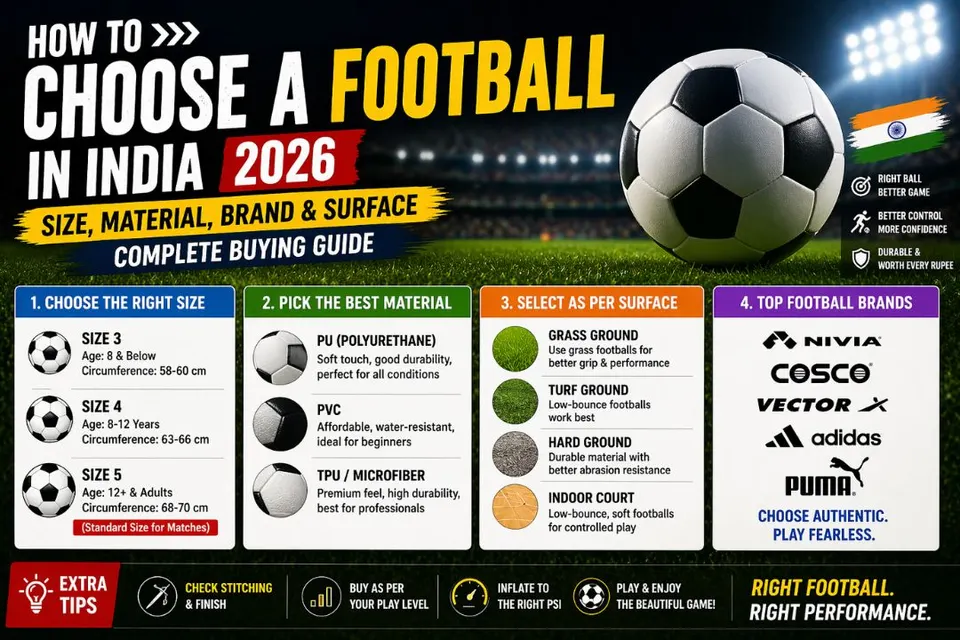
This guide explains exactly how to choose a football in India in 2026, covering size, material, panel construction, brand, surface suitability, and budget.
Football size is standardised globally. Using the wrong size for your age group creates technical problems — young players develop incorrect kicking mechanics with balls too large and heavy for their body size.
Size | Circumference | Weight | Age Group |
|---|---|---|---|
Size 1 | 43–46 cm | 195–205g | Skills ball, any age |
Size 2 | 54–56 cm | 250–280g | Skills/futsal, under 6 |
Size 3 | 58–60 cm | 300–320g | Children, 5–8 years |
Size 4 | 62–64 cm | 350–390g | Youth players, 8–14 years |
Size 5 | 68–70 cm | 410–450g | Adults, 14 years+ |
Size 5 is the match standard for all adult football. Any player over 14 years old playing formal club or school football should use a size 5 ball.
Size 4 for youth (8-14 years): Critical for technique development. A size 5 ball on an 8-year-old forces them to use their whole body for kicks they should be developing with proper foot technique on a lighter, smaller ball.
Size 3 for young children (5-8 years): Easier to control, safer on impact, and develops more accurate first-touch skills than larger balls.
PU (Polyurethane): The best material for football casing. Soft, responsive, weather-resistant, and retains shape under hard use. Used in match balls and quality training balls. What you should look for in any ball above ₹500.
PVC (Polyvinyl Chloride): Harder, shinier surface. More durable on concrete and rough surfaces but significantly reduced feel. Suitable for recreational play on hard surfaces where longevity matters more than touch.
Genuine Leather: Rarely used in modern footballs. Absorbs water, loses shape, and requires maintenance. Only found in very expensive specialist balls.
Synthetic Leather: A mid-grade option. Better feel than PVC, less responsive than PU. Common in mid-range training balls.
Butyl Bladder: Retains air pressure for longer — often 2-3 weeks before needing inflation. Slightly harder feel. Best for training balls where convenience matters.
Latex Bladder: Better rebound and softer touch. Used in match-quality balls. Requires more frequent inflation (every 4-7 days) but delivers superior playing feel.
Hand-Stitched: Premium. Panels are individually sewn together — creates superior air retention, better shape integrity, and longer life. All serious match balls are hand-stitched.
Machine-Stitched: Standard for training balls. Cost-effective, adequate for regular use, but slightly less durable than hand-stitched.
Thermally Bonded (Seamless): Used in top-tier match balls (FIFA approved). No stitching — panels are fused together. Provides perfect sphericity and consistent movement through air. Not necessary for club or school level.
The playing surface determines which outer material and sole construction survives.
Artificial Turf (Astroturf): Use PU-cased balls with butyl bladders. Avoid genuine leather — turf fibres cause rapid surface wear. PU handles the abrasive texture well without deteriorating quickly.
Concrete / Hard Court: PVC-cased balls survive the longest. They're harder underfoot but significantly more resistant to the rapid scuffing that destroys PU on concrete. Alternatively, buy cheaper PU balls with the expectation of replacement every 2-3 months.
Natural Grass: Premium PU, hand-stitched, latex bladder. Grass is the most forgiving surface for ball materials. Use the best ball you can justify here — the surface allows you to feel the true quality difference.
Indoor (Wooden or Synthetic Floor): Smaller panels, lower bounce rate, size 5 or futsal-specific size 4 low-bounce ball. Standard outdoor balls have too much bounce for indoor halls and compromise ball control development.
Nivia is the most trusted Indian football manufacturer. Their balls consistently deliver quality matched to price across all categories — from school practice balls to competitive club-match footballs. The Nivia Storm and Nivia Premier ranges are particularly recommended for club use.
Best Nivia Football: Nivia Storm (training, ₹600–₹900), Nivia Premier Gold (match, ₹1,500–₹2,500)
Vector X offers the best value at the entry-level price point. Their footballs in the ₹300–₹700 range are adequate for casual and recreational play, with durability that exceeds the price point. Not recommended for formal competitive play but excellent for school and backyard use.
Adidas's training and match ball ranges (Tiro, Conext, Al Rihla training editions) are widely available in India and deliver the quality that global match performance demands. Expensive by Indian standards (₹2,000–₹6,000) but genuinely match-grade for club competition.
Best Adidas Football for India: Adidas Tiro Training Ball (₹1,200–₹2,000) for serious training; Adidas Conext (₹2,000–₹3,500) for competitive matches.
Cosco is a widely available Indian brand with broad distribution. Their balls are reliable in the ₹400–₹1,200 range, particularly for school and casual club use. Not at Nivia's level for match play but consistent for training.
Purpose | Ball Type | Recommended Brand | Budget |
|---|---|---|---|
Casual backyard/street play | PVC, machine-stitched | Cosco, Vector X | ₹300–₹600 |
School training | PU, machine-stitched, butyl | Nivia, Cosco | ₹600–₹1,200 |
Club training (regular) | PU, machine-stitched, butyl | Nivia, Adidas Tiro | ₹1,000–₹2,000 |
Competitive club matches | PU, hand-stitched, latex | Adidas, Nivia Premier | ₹1,800–₹4,000 |
Youth/children's football | PU or PVC, size 3 or 4 | Nivia, Cosco | ₹400–₹1,000 |
Inflate to correct pressure. Over-inflation causes the ball to bounce unpredictably and stresses the stitching. Under-inflation produces a "dead" feel. Standard pressure: 0.6–0.9 bar (8.5–13 PSI). Check with a pump gauge.
Store away from direct sunlight. UV degrades PU and PVC casings, causing cracking and loss of flexibility. Store footballs indoors when not in use.
Clean after use on dirty or wet surfaces. Mud left to dry in stitching causes premature deterioration of thread. Wipe down after muddy sessions.
Don't use match balls for concrete practice. A ₹3,000 hand-stitched PU match ball on concrete court lasts 2-3 weeks. Use PVC or cheap PU for hard surface training.
Rotate between two balls if training daily. Bladders hold their pressure better with rest between sessions. Two balls used alternately last longer than one used daily.
Choosing the right football in India comes down to five questions: What age is the player? What surface are they playing on? Is it for training or matches? What's the budget? And how much does touch and feel matter?
Answer these correctly and the choice is simple. Size 5 for adults. PU casing for quality play. Nivia or Adidas for reliability. PVC for hard ground durability. Hand-stitched and latex bladder for match play.
Browse SportsGear24x7's complete football range — match balls, training balls, and youth footballs across all sizes and brands.
Q1: What size football is best for adults?
Adults (14 years and older) should use Size 5 — the standard match size with 68–70cm circumference and 410–450g weight. All adult competitive football uses size 5.
Q2: What is the best football material for Indian conditions?
PU (Polyurethane) is the best material for most Indian conditions — durable on artificial turf, excellent feel on grass, and weather-resistant. Use PVC on concrete surfaces for better abrasion resistance.
Q3: Which football brand is best in India in 2026?
Nivia is the most consistently recommended Indian football brand for quality-to-price ratio. Adidas leads for competitive match-quality balls. Vector X and Cosco offer the best budget options.
Q4: What is the best football for artificial turf in India?
A size-appropriate (size 5 for adults) PU-cased ball with a butyl bladder is ideal for artificial turf. Avoid genuine leather. The Nivia Storm or Adidas Tiro training balls are both recommended for turf surfaces.
Q5: How do I know if a football is good quality?
Check for: PU outer casing (not PVC), hand-stitching rather than machine-stitching on the seams, a latex or quality butyl bladder (indicated by rebounding responsiveness), consistent spherical shape, and a pressure marking of 0.6–0.9 bar.
The SportsGear24x7 Editorial Team is a group of passionate cricket enthusiasts and equipment specialists based in New Delhi, India. With over a decade of experience in the cricket gear industry, our team has helped thousands of players — from beginners to state-level competitors — find the right equipment for their game. Every article we publish is backed by real product knowledge, on-ground player feedback, and deep understanding of the Indian cricket ecosystem.