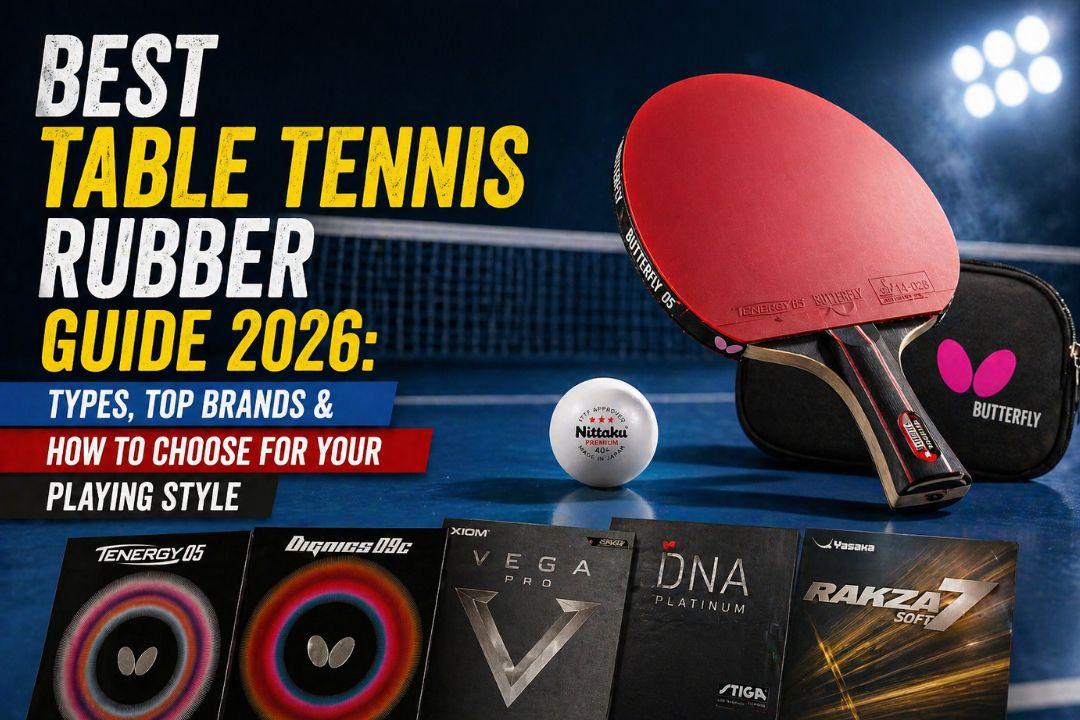


Ask a table tennis beginner what makes their bat perform better and they'll tell you it's the blade. Ask an advanced player and they'll tell you it's the rubber.
Both are partially right — but at every level beyond complete beginner, rubber selection has a more immediate and dramatic impact on performance than the blade beneath it. The rubber determines your spin, your speed, your control, and the kind of game you're able to play. A mediocre blade with excellent rubber outperforms an excellent blade with mediocre rubber at virtually every level of play.
Yet most players — even those who've been playing table tennis for years — know very little about rubber selection beyond "Butterfly makes good stuff."
This guide fixes that. Complete table tennis rubber breakdown for 2026 — types, top brands, how to read specifications, and specific recommendations by playing level and style.
Inverted rubber — also called pimples-in — is the overwhelming standard for competitive table tennis. The pimples face inward (toward the sponge layer), leaving a smooth outer surface exposed.
What it produces: Maximum spin, maximum speed when combined with the right sponge, and excellent ball control for rallies. Topspin looping, backspin pushes, and aggressive drives are all maximised with inverted rubber.
Who uses it: 95%+ of competitive table tennis players at every level above recreational. If you watch professional table tennis — inverted rubber on both sides.
Thickness categories:
Thin (1.5–1.8mm sponge): More control, less speed and spin. Ideal for beginners and control-focused players.
Medium (1.9–2.0mm): Balanced. Most intermediate players use this range.
Max/Thick (2.0–2.2mm and above): Maximum speed and spin. For advanced players who generate their own control through technique.
Short pimples face outward — the tips of the pimples are the playing surface. This creates a different ball interaction: less spin sensitivity (incoming spin affects the ball less), faster off the blade, and a flatter trajectory on attacking shots.
What it produces: Fast, flat attacking shots. Less susceptibility to heavy topspin — ideal for blocking and counter-hitting against aggressive loopers.
Who uses it: Players who prefer a speed-and-flat-attack game over spin-based play. Common among blockers and counter-hitting specialists.
Long pimples are the specialist's tool — they reverse or neutralise spin on contact, producing confusing returns that disrupt opponents' rhythm. Used almost exclusively as a defensive or disruptive tool.
What it produces: Reversed spin on returns (pushes return as topspin, topspin returns as backspin). Disorienting for opponents unfamiliar with long pimple play.
Who uses it: Defensive choppers, disruptive players, specialists who build a game around opponent confusion.
Not recommended for: Beginners or players still developing fundamental technique. Long pimples require experience to understand what they're doing to the ball.
A smooth surface with very soft sponge that absorbs spin rather than interacting with it. Returns come back with minimal spin regardless of what was put on the ball.
Who uses it: Specialist defensive players, often combined with inverted rubber on the other side for maximum tactical variety.
Butterfly (Tamasu) is the benchmark for premium table tennis rubber. Japanese manufacturing, the most used brand among professional players globally, and consistently the most copied specifications in the market.
Best Butterfly Rubbers 2026:
Tenergy 05: The most acclaimed table tennis rubber of the modern era. High-tension spring sponge, inverted, 2.1mm. Extraordinary topspin capability and speed. The choice of numerous world-ranked players. Expensive — but genuinely earns its reputation. Price: ₹3,500–₹5,000 per sheet
Rozena: Butterfly's accessible premium rubber — similar technology to Tenergy at approximately 60% of the price. Excellent for club-level advanced players who want Butterfly quality without Tenergy pricing. Price: ₹2,000–₹3,200 per sheet
Sriver: Butterfly's classic training rubber. Used as a benchmark for comparison across the industry. Excellent for intermediate players developing their game. Price: ₹800–₹1,500 per sheet
DHS is China's leading table tennis brand — and China produces the world's best players. The Hurricane series is particularly notable as the rubber used by Chinese national team members.
Best DHS Rubbers 2026:
DHS Hurricane 3: China's national team rubber. Sticky inverted, designed for extreme topspin and spin-sensitive control. Requires specific technique to use effectively — the tacky surface rewards players who brush the ball with a fast swing. Price: ₹1,200–₹2,000 per sheet
DHS Gold Arc 8: A more accessible DHS rubber without the tacky surface. Better all-round performance for players who haven't yet mastered Chinese-style brushing technique. Price: ₹1,000–₹1,600 per sheet
German manufacturer Tibhar produces rubbers optimised for the European playing style — faster, more direct attacks, less reliance on extreme spin than Chinese rubbers.
Best Tibhar Rubber 2026:
Tibhar Evolution MX-P: One of the most popular rubbers among advanced European-style players. High-tension, inverted, 2.1–2.2mm. Exceptional speed and looping capability. Suits players who attack consistently from both wings. Price: ₹2,000–₹3,000 per sheet
Japanese brand Yasaka offers excellent quality at more accessible prices than Butterfly's premium range. The Mark V is one of the most respected intermediate rubbers in the world.
Yasaka Mark V: Clean inverted rubber with excellent all-round performance. Predictable flight, good topspin capability, and durable. One of the best rubbers for developing technique at intermediate level. Price: ₹900–₹1,600 per sheet
Recommendation: ITTF-approved inverted rubber, 1.5–1.8mm sponge, medium speed and spin rating.
Why: Thin sponge gives more control and slows the ball enough for beginners to maintain rallies and develop stroke mechanics. A fast, thick rubber produces erratic shots that teach nothing.
Specific pick: Yasaka Mark V (1.5mm), DHS Gold Arc 8 (1.8mm), or Butterfly Sriver (1.8mm) Budget: ₹800–₹1,500 per sheet
Recommendation: Inverted rubber, 1.9–2.0mm sponge, medium-high speed and spin.
Why: Intermediate players are developing their looping, serving, and transition game. More sponge thickness provides the speed needed to compete while the inverted surface maximises spin learning.
Specific pick: Butterfly Rozena (2.0mm), Tibhar Evolution MX-S (1.9mm), DHS Gold Arc 8 (2.0mm) Budget: ₹1,200–₹2,500 per sheet
Recommendation: High-tension inverted rubber, 2.1–2.2mm or Max, chosen by playing style.
Speed/Attack style: Butterfly Tenergy 05, Tibhar Evolution MX-P Topspin/Chinese style: DHS Hurricane 3 All-round control: Butterfly Rozena, Yasaka Mark V (Max) Budget: ₹2,000–₹5,000 per sheet
When you see rubber listed with speed/spin/control ratings (typically on a scale of 1-10 or 1-100):
Speed: How fast the ball leaves the rubber. Higher = more pace, less forgiveness on mishits. Spin: How much rotation the rubber generates. Higher = more topspin potential, requires better brushing technique. Control: How predictable and manageable the rubber is. Higher control = more forgiveness.
Rule of thumb: Beginners should prioritise control (7+). Intermediates should balance spin and control (spin 7+, control 6+). Advanced players choose based on their specific attacking or defensive system.
Clean after every session. Use a rubber cleaning foam or damp cloth to remove oils, dust, and shuttle fibres. Dirty rubber loses tackiness and spin generation rapidly.
Store with a protective sheet. Rubber sheets (often included with rubbers) protect the surface between sessions. Exposure to air degrades the surface over time.
Replace every 3-6 months. Rubber degrades through play — the sponge loses tension and the surface loses tackiness. Even if the rubber looks fine, performance drops significantly after 80-100 hours of play.
Match forehand and backhand rubber to your style. Many players use different rubbers on each side — faster on the forehand wing for attacking, more controlled on the backhand for consistent looping. This is normal and recommended.
Table tennis rubber selection is the single highest-impact equipment decision in the sport. The right rubber for your level and playing style transforms your game. The wrong rubber creates habits you'll need to unlearn.
Beginners: start with Yasaka Mark V or DHS Gold Arc 8 at 1.5-1.8mm. Intermediate players: upgrade to Butterfly Rozena or Tibhar Evolution. Advanced players: Butterfly Tenergy 05 for speed, DHS Hurricane 3 for Chinese-style topspin mastery.
Browse SportsGear24x7's complete table tennis range — rubbers, blades, complete bats, balls and accessories with fast delivery across India.
Q1: What is the best table tennis rubber for beginners in India? The Yasaka Mark V (1.5mm) and DHS Gold Arc 8 (1.8mm) are the most recommended beginner rubbers. They offer predictable control, adequate spin for developing technique, and durability at accessible prices.
Q2: What is the difference between inverted and pimples rubber in table tennis? Inverted (smooth face) rubber is the standard for spin-based play — pimples face inward, leaving a smooth surface that maximises topspin and backspin. Short pimples face outward, producing faster, flatter shots less affected by incoming spin.
Q3: Is Butterfly table tennis rubber worth the price? Butterfly rubbers — particularly the Tenergy range — are priced significantly higher than alternatives but deliver measurable performance advantages for advanced players. For beginners and intermediate players, Yasaka and DHS offer comparable quality at more accessible prices.
Q4: How often should you replace table tennis rubber? Replace rubber every 3-6 months with regular play (3+ sessions per week). The first sign of degradation is reduced spin generation — the surface feels less grippy and balls sit flatter on your loops.
Q5: What rubber thickness should a beginner use? Beginners should use 1.5–1.8mm sponge thickness. Thinner sponge provides more control and slows the ball to a manageable speed while technique is being developed. Avoid Max (2.2mm+) until your stroke mechanics are well established.
Share
The SportsGear24x7 Editorial Team is a group of multi-sport gear specialists and equipment enthusiasts based in New Delhi, India. With 10+ years of experience across cricket, tennis, badminton, football, and more — our team has helped thousands of players at every level find the right gear for their game. Every article we publish is backed by genuine product expertise, real player feedback, and a deep passion for sport.