Yonex Nanoflare Speed 7 vs Astrox Attack 9: Which Yonex Racket Should You Buy in 2026?
Updated 6 min read


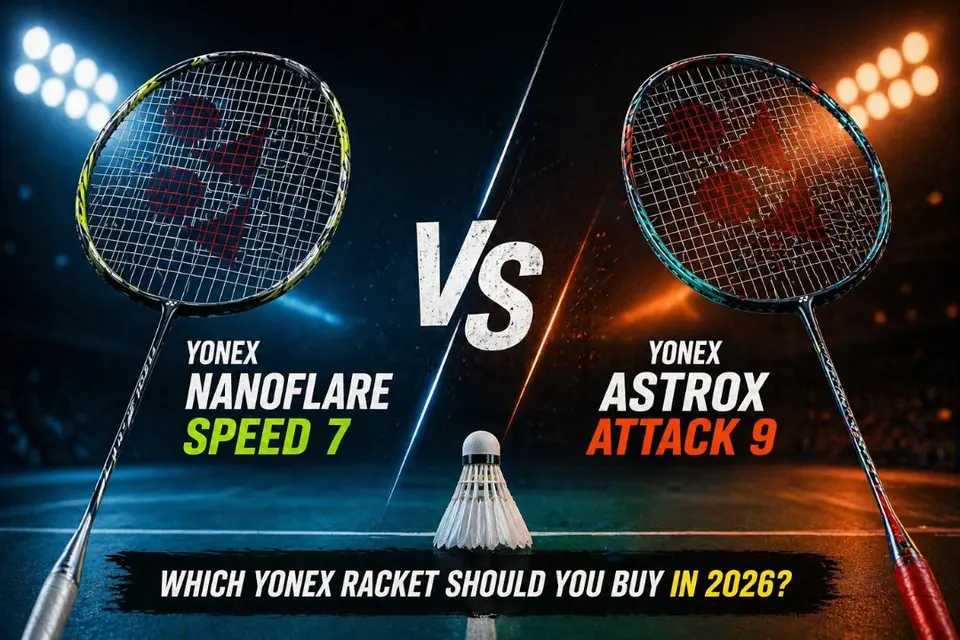
Two Yonex rackets. Both mid-range price points. Both with strong reputations in Indian badminton circles. But the Nanoflare Speed 7 and the Astrox Attack 9 are built for fundamentally different players — and buying the wrong one is a mistake that will show up in your game every session.
This is a detailed, technical comparison between the Yonex Nanoflare Speed 7 and the Yonex Astrox Attack 9 for 2026, covering shaft stiffness, balance point, swing weight, playing style suitability, and a clear recommendation based on how you actually play.
Yonex Nanoflare Speed 7: Built for speed. The "Nanoflare" series across Yonex's range prioritises fast swing speed, quick recovery between shots, and a head-light balance that suits defensive players, fast-court doubles specialists, and players who rely on wrist-driven technique.
Yonex Astrox Attack 9: Built for attack. The "Astrox" series is Yonex's attack-oriented lineup — head-heavy balance, rotational force engineering, and a shaft designed to store energy for powerful smashes. Suits players who like to dominate from the back of the court.
The names tell you everything: Speed vs Attack. Fast vs Powerful. The question is which describes your game.
Specification | Nanoflare Speed 7 | Astrox Attack 9 |
|---|---|---|
Series | Nanoflare (Speed) | Astrox (Attack) |
Balance | Head-Light | Head-Heavy |
Shaft Stiffness | Flexible | Medium-Stiff |
Recommended String Tension | Up to 30 lbs | Up to 28 lbs |
Weight | 4U (80–84.9g) | 4U (80–84.9g) |
Grip Size | G4 (standard) | G4 (standard) |
Frame Material | Graphite | Graphite |
Best Playing Style | Speed, control, defence | Power smash, attack |
Approx. Price (India) | ₹4,000–₹6,500 | ₹4,500–₹7,000 |
Head-Light (Nanoflare Speed 7): The balance point sits closer to the handle. This makes the racket feel lighter during the swing, allows faster arm recovery between shots, and produces quicker wrist movements. The trade-off is less power on smashes — there's less rotational mass at impact.
Head-Heavy (Astrox Attack 9): The balance point sits closer to the frame. This creates more momentum at impact — more power transferred to the shuttle on smashes and drives. The trade-off is slightly slower swing speed and recovery.
In practical terms: if you play a reaction-based game — lots of net duals, quick returns at the kitchen, doubles with short exchanges — the Nanoflare Speed 7's head-light feel gives you the advantage. If you play a rally-based game where you build to an overhead smash opportunity, the Astrox Attack 9 finishes points more decisively.
Nanoflare Speed 7 — Flexible Shaft: A flexible shaft bends more during the swing, storing and releasing energy through the natural whipping motion of the follow-through. This assists players who don't generate maximum arm speed by adding shaft-generated power to the shot. Flexible shafts also produce better feel on touch shots — drops, slices, and net kills.
Best for: Intermediate players, doubles players, players still developing arm speed
Astrox Attack 9 — Medium-Stiff Shaft: A stiffer shaft transfers energy more directly from arm to shuttle — less flex means less energy loss for players who already generate strong swing speed. The result is more precise shot direction and sharper smash velocity for technically sound strikers.
Best for: Players with established smash technique, singles players, aggressive attackers
You play doubles primarily and value fast exchanges at the net
Your game is built on speed, deception, and variety rather than raw power
You're an intermediate player still developing your overhead technique
You've experienced arm fatigue or elbow discomfort with heavier rackets
You play a defensive game and need to recover quickly after blocks
You like to use wrist-flick techniques for cross-court shots and net drops
You play singles and rely on building pressure through the back of the court
Your strongest weapon is the overhead smash and you want to maximise it
You have technically sound overhead mechanics and generate good arm speed
You play doubles in a back-court dominator role
You prefer power over pace — fewer shots, more decisive ones
You want a racket that rewards committed swings rather than wristy technique
Nanoflare Speed 7: The flexible shaft combined with the head-light balance creates maximum repulsion at 24–27 lbs. Going above 27 lbs reduces the shuttle's dwell time in the string bed — eliminating one of the racket's key performance advantages.
Astrox Attack 9: The medium-stiff shaft is designed to handle higher tensions. 25–28 lbs is the optimal range for smash players. Higher tension allows the stiffer shaft to drive shuttle speed from swing power rather than string flex.
At their current Indian market prices:
Nanoflare Speed 7 (₹4,000–₹6,500): Strong value. Yonex's Nanoflare technology at a price accessible to intermediate club players. The racket delivers genuine performance improvement over unbranded alternatives and lower-tier rackets.
Astrox Attack 9 (₹4,500–₹7,000): Also strong value. The Astrox series technology at a competitive price point. Players who smash consistently will feel the difference over fibreglass or basic graphite alternatives immediately.
Price difference consideration: The Astrox Attack 9 is typically ₹500–₹1,500 more than the Nanoflare Speed 7. If your game style clearly matches the Astrox — power, smash, singles — the premium is justified. If you're unsure, the Nanoflare Speed 7's versatility makes it the safer investment.
The Yonex Nanoflare Speed 7 and Astrox Attack 9 are both excellent rackets for their respective playing styles. The choice is not about which is "better" — it's about which matches your game.
Speed, net play, doubles, defensive reactions, wrist technique: Nanoflare Speed 7. Power, smash, singles, back-court domination, technical overhead: Astrox Attack 9.
If you're genuinely split between the two, ask yourself: would you rather win the point with a fast reaction or a decisive smash? Your honest answer points to your racket.
Browse SportsGear24x7's complete Yonex badminton racket range — including the Nanoflare Speed 7 and Astrox Attack 9 — with fast delivery across India.
Q1: Which is better — Yonex Nanoflare Speed 7 or Astrox Attack 9? Neither is objectively better — they suit different playing styles. The Nanoflare Speed 7 is better for fast doubles play and speed-based games. The Astrox Attack 9 is better for power smash and singles play. Choose based on your style, not brand preference.
Q2: What is the price of Yonex Nanoflare Speed 7 in India 2026? The Yonex Nanoflare Speed 7 typically retails between ₹4,000 and ₹6,500 in India in 2026 depending on retailer and colour variant.
Q3: Is Astrox Attack 9 good for beginners? The Astrox Attack 9's head-heavy balance and medium-stiff shaft require reasonable arm speed to perform optimally. Beginners typically benefit more from the Nanoflare Speed 7's flexible shaft and head-light balance, which assists with early smash development without requiring perfect technique.
Q4: What string tension should I use for the Yonex Nanoflare Speed 7? 24–27 lbs is the optimal range for the Nanoflare Speed 7. This tension range complements the flexible shaft's energy storage and maintains the shuttle dwell time that produces the racket's characteristic feel.
Q5: Can I use the Astrox Attack 9 for doubles? Yes, but it's not the ideal choice for doubles players who prioritise speed and net play. The head-heavy balance slows recovery between quick exchanges. The Nanoflare Speed 7 or Nanoflare 700 would be more appropriate for fast doubles play.
The SportsGear24x7 Editorial Team is a group of passionate cricket enthusiasts and equipment specialists based in New Delhi, India. With over a decade of experience in the cricket gear industry, our team has helped thousands of players — from beginners to state-level competitors — find the right equipment for their game. Every article we publish is backed by real product knowledge, on-ground player feedback, and deep understanding of the Indian cricket ecosystem.