What Is a Kitchen in Pickleball? Rules, Strategy & Why It Changes the Entire Game
6 min read


If you have just started playing pickleball — or watched a match for the first time — one word keeps coming up: the kitchen.
Players shout it, referees call faults because of it, and experienced players obsess over controlling it. But what exactly is the kitchen in pickleball, and why does it matter so much?
This guide explains the kitchen rule clearly and completely — from the basic definition to fault scenarios and advanced strategy — so you can play smarter from day one.
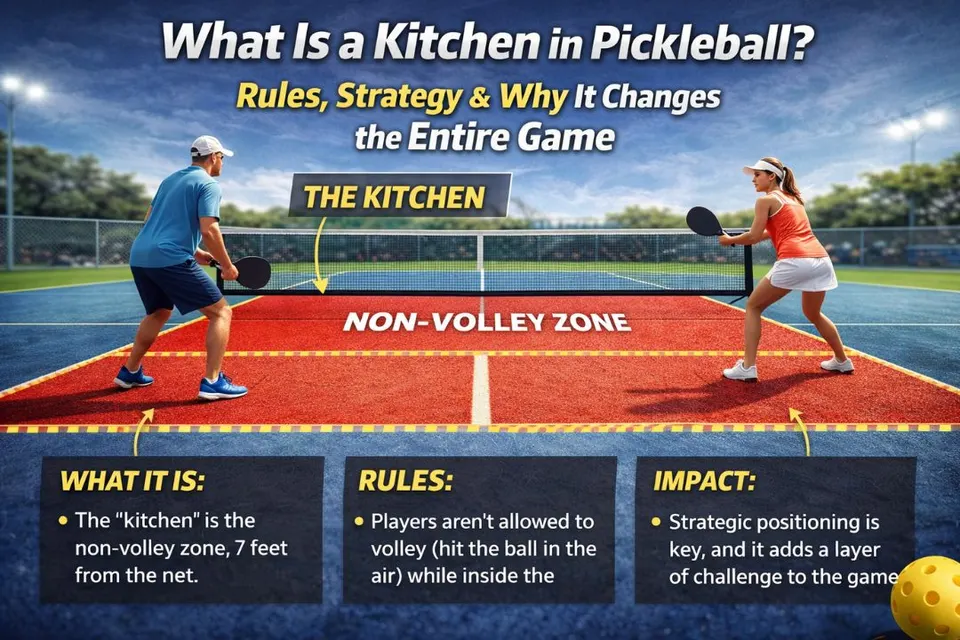
In pickleball, the kitchen is the non-volley zone (NVZ) — a 7-foot area on each side of the net that runs the full width of the court (20 feet wide). The kitchen includes the lines themselves.
The rule is simple in principle: you cannot volley the ball while standing inside the kitchen or while touching the kitchen line. A volley is any shot played before the ball bounces on the ground.
This rule is unique to pickleball. No other major racket sport has an equivalent zone — and it is the single rule that defines pickleball's distinctive strategic character.
According to USA Pickleball's official rulebook, the non-volley zone rule was specifically designed to prevent players from dominating points purely through aggressive net play — creating a game that rewards precision, patience, and placement over raw power.
You CAN do the following in the kitchen:
Enter the kitchen at any time to play a ball that has bounced
Stand in the kitchen during a rally as long as you do not volley
Hit a dink shot from inside the kitchen after the ball has bounced
You CANNOT do the following:
Volley (hit the ball before it bounces) while standing in the kitchen
Volley while your momentum carries you into the kitchen after the shot
Volley while any part of your body — including your paddle or clothing — touches the kitchen or its lines
The momentum rule is the one that catches most beginners: If you jump and volley from just outside the kitchen but land inside it, that is still a fault — even though you were technically outside when you made contact with the ball.
These are the most common kitchen faults that beginners and intermediate players commit:
Fault | Why It Happens |
|---|---|
Volleying with foot on the kitchen line | Foot position not checked before shooting |
Momentum carry into kitchen after volley | Playing too aggressively at the net |
Paddle touches kitchen line after volley | Poor shot follow-through control |
Partner steps into kitchen before ball bounces | Positioning error in doubles |
Understanding the kitchen is not just about avoiding faults — it fundamentally shapes how winning pickleball is played.
At the beginner level: The kitchen prevents players from camping at the net and smashing every ball. It forces everyone to use ground strokes and controlled placement.
At the intermediate level: Winning players use dink shots — soft shots played into the kitchen from the kitchen line — to move their opponents around, create errors, and set up winning attacks.
At the advanced level: Kitchen management becomes the primary competitive skill. The player who controls the kitchen line — approaching it safely after the ball bounces, and forcing their opponent to deal with difficult dinks — wins the majority of rallies.
This is why the kitchen is often called "the most strategic space in pickleball." Mastering it is the difference between a recreational player and a competitive one.
Approach the kitchen line carefully — move up after shots that bounce, never rush the net and volley recklessly
Use dinks to neutralise aggressive players — soft, low shots into the kitchen are extremely hard to attack
Watch your feet at all times — the kitchen line fault is the most common and easiest to prevent
In doubles, communicate with your partner about kitchen positioning — both players should ideally be at the kitchen line together
For more on improving your pickleball game, read Tips for Improving Your Pickleball Game with Focused Practice and Pickleball Doubles Strategy: How to Build Team Chemistry and Win More Matches.
Mastering kitchen strategy requires control — and control starts with the right paddle. Browse our pickleball equipment range at SportsGear24x7, including paddles suited for dink accuracy, court control, and power hitting.
Also explore our pickleball guides including How to Choose the Best Pickleball Paddle for Your Playing Style and Budget — the first step to playing great pickleball starts with the right paddle in your hand.
Q1. What is the kitchen in pickleball? The kitchen in pickleball is the non-volley zone (NVZ) — a 7-foot zone extending from the net on both sides of the court. Players cannot volley (hit the ball before it bounces) while standing in the kitchen or while touching its boundary lines. It is one of pickleball's most distinctive and strategically important rules.
Q2. Can you stand in the kitchen in pickleball? Yes — you can stand in the kitchen at any time during a rally. The restriction is specifically on volleying from the kitchen. You are allowed to stand in the kitchen and play shots after the ball has bounced in the kitchen area. Players often move into the kitchen intentionally to play dink shots.
Q3. What happens if you step into the kitchen during a volley in pickleball? Stepping into the kitchen during a volley — or being carried into it by momentum after a volley — is a fault. The point is awarded to the opposing team. This rule applies even if only your toe, the edge of your shoe, or your paddle touches the kitchen line at the time of the volley.
Q4. Why is the non-volley zone called the kitchen in pickleball? The exact origin of the term "kitchen" in pickleball is debated among players. The most widely accepted explanation is that it derives from the shuffleboard term "in the kitchen," which refers to a penalty area where landing results in a negative outcome — similar to committing a kitchen fault in pickleball.
Q5. What is a dink shot in pickleball and how does it relate to the kitchen? A dink is a soft, low shot played from near the kitchen line that arcs gently over the net and lands in the opponent's kitchen (NVZ). Since the ball must bounce before the opponent can play it, dink shots force a neutral kitchen battle rather than allowing an aggressive volley. Mastering the dink is essential to controlling kitchen play and winning points at higher levels of pickleball.
The SportsGear24x7 Editorial Team is a group of passionate cricket enthusiasts and equipment specialists based in New Delhi, India. With over a decade of experience in the cricket gear industry, our team has helped thousands of players — from beginners to state-level competitors — find the right equipment for their game. Every article we publish is backed by real product knowledge, on-ground player feedback, and deep understanding of the Indian cricket ecosystem.