

Ask any experienced football coach in India what the most common beginner mistake is, and you will hear the same answer repeatedly: wearing the wrong shoes for the playing surface.
Playing football in the wrong footwear does not just hurt your performance — it increases your risk of ankle sprains, knee injuries, and slipping at critical moments. Understanding the difference between turf shoes, cleats, and flat sole football shoes is not optional knowledge. It is the foundation of playing safely and performing well.
This guide explains each shoe type, when to use them, and how to choose the right pair for the surfaces you actually play on in India.
According to FIFA's equipment guidelines, football footwear is required to be safe and appropriate to the playing surface — not just for performance, but to protect the player and their teammates. The wrong outsole on the wrong surface creates dangerous traction inconsistencies that lead to falls, twisted ankles, and torn ligaments.
In India, most players encounter a mix of surfaces — artificial turf, concrete, packed earth, or natural grass. Each surface demands a different outsole configuration for safe, effective play.
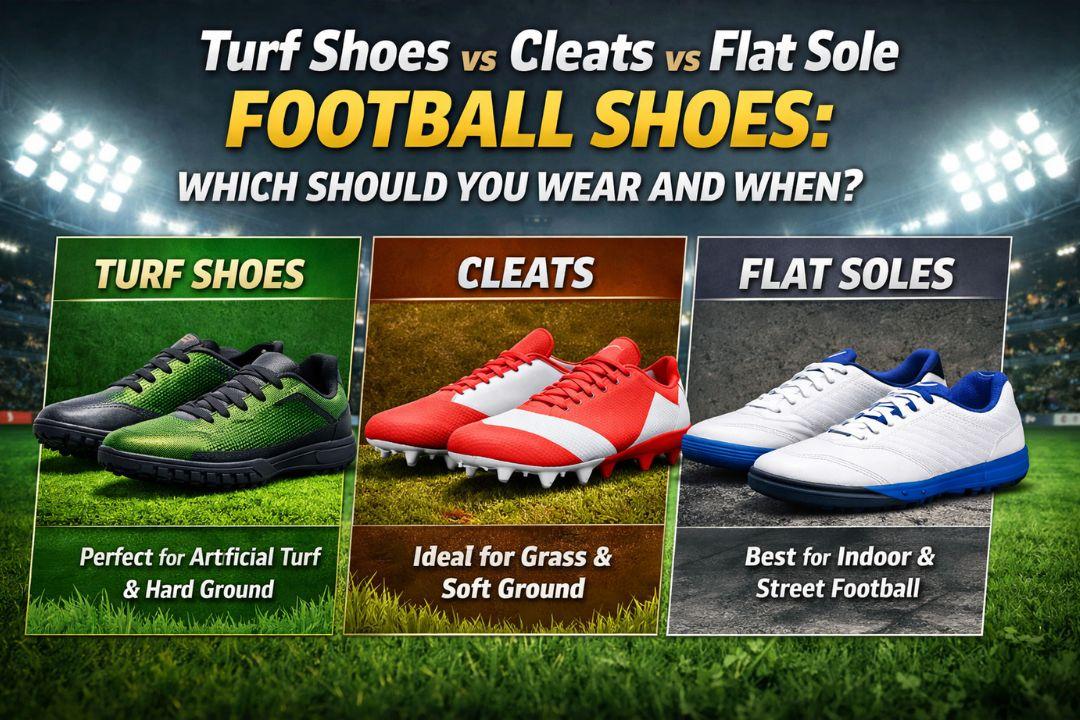
Best surface: Artificial turf (the rubberised green astroturf found in most urban football academies and sports complexes across India)
Outsole design: Dozens of small, short rubber studs spread evenly across the outsole
Turf shoes are the most widely useful football footwear for players in Indian cities. Most urban football academies, school sports grounds, and commercial football facilities use artificial turf surfaces. The densely studded outsole of turf shoes distributes pressure evenly across the surface, provides consistent grip without digging in, and significantly reduces strain on the knees and ankles compared to wearing metal or hard plastic cleats on artificial turf.
Advantages:
Excellent grip and traction on artificial turf
Comfortable for extended training sessions
Safe for knees and joints on hard turf surfaces
Versatile — usable on compacted earth and some outdoor concrete areas
Who should buy turf shoes: Any player who trains primarily at an artificial turf facility, which describes the majority of urban academy and club players in India today.
Shop football shoes at SportsGear24x7 — including turf-specific models for junior and adult players.
Best surface: Natural grass — both firm ground (FG) and soft ground (SG)
Outsole design: Fewer, longer studs made from rubber, plastic, or metal that penetrate the ground surface
Football cleats are designed specifically for natural grass pitches. The longer studs dig into the ground to provide powerful traction for acceleration, turning, and braking on grass surfaces.
There are two variants:
FG (Firm Ground) cleats — rubber or plastic studs, suitable for dry, firm natural grass
SG (Soft Ground) cleats — metal-tipped studs, suitable for wet, soft grass where deeper penetration is needed
Critical warning: Never wear FG or SG cleats on artificial turf. The longer studs catch on turf fibres, create dangerous tripping hazards, and dramatically increase knee injury risk.
Who should buy cleats: Players competing in formal league matches or tournaments held on natural grass pitches — common in rural and semi-urban India, and in organised district and state-level competitions.
Best surface: Indoor futsal courts, smooth wooden gym floors, or sports hall surfaces
Outsole design: Flat, grippy rubber outsole with no studs at all
Flat sole football shoes (also called indoor or futsal shoes) are designed for smooth, hard indoor court surfaces. The flat outsole maximises contact area, providing grip through friction rather than penetration.
Advantages:
Excellent grip on smooth indoor courts
Lightweight and low-profile
Good for futsal, small-sided indoor games, and gym training
Who should buy flat sole shoes: Players who train or compete indoors on futsal courts — a growing format in Indian cities.
Shoe Type | Best Surface | Stud Type | Avoid On |
|---|---|---|---|
Turf (TF) | Artificial turf | Many short rubber studs | Wet natural grass |
Firm Ground (FG) | Dry natural grass | Fewer longer plastic studs | Artificial turf |
Soft Ground (SG) | Wet natural grass | Metal-tipped studs | Artificial turf / Hard ground |
Indoor (IC/IN) | Smooth indoor courts | No studs / flat rubber | Any outdoor surface |
For most players in Indian cities in 2026:
Primary purchase: Turf shoes — covers 80% of Indian playing environments
Secondary purchase: FG cleats — if you play on natural grass in formal leagues
Optional: Indoor flats — only if you regularly play futsal indoors
Browse our full range of football shoes and football equipment at SportsGear24x7.
Also read our guides: Best Football Shoes for Turf, Ground & Indoor: Complete Buying Guide 2026 and Essential Football Protective Gear Every Player Must Have before completing your football kit.
Q1. Can I wear football cleats on artificial turf in India? No — wearing firm ground or soft ground cleats on artificial turf is dangerous and damaging. The longer studs catch on turf fibres, increase knee and ankle injury risk significantly, and can also damage the turf surface itself. Always use turf-specific shoes (TF) on artificial surfaces.
Q2. What football shoes are best for concrete surfaces in India? For concrete or packed earth surfaces — common in Indian streets, parks, and informal play areas — turf shoes or flat sole shoes are the safest choice. They provide adequate grip without the hard protrusions of cleats that become painful and unstable on concrete.
Q3. What is the difference between FG and SG football cleats? FG (Firm Ground) cleats have fixed rubber or hard plastic studs suitable for dry, hard natural grass. SG (Soft Ground) cleats have fewer, replaceable metal-tipped studs designed for wet, soft grass where deeper penetration is needed for traction. Most Indian players on natural grass pitches will find FG cleats sufficient.
Q4. Do kids need different football shoes than adults? Yes — children's football shoes are specifically designed for smaller feet with wider toe boxes and softer materials to support growing foot development. Junior turf shoes are recommended for most school-age children training on artificial surfaces. Never put an adult in a child's shoe or vice versa.
Q5. How long do football shoes typically last? Football shoes used 3–4 times per week typically last 6–12 months before the outsole and upper show significant wear. Turf studs wear down faster on abrasive artificial surfaces. Rotate between two pairs if possible to extend each pair's lifespan, and always allow shoes to dry fully before storage to prevent material breakdown.
The SportsGear24x7 Editorial Team is a group of multi-sport gear specialists and equipment enthusiasts based in New Delhi, India. With 10+ years of experience across cricket, tennis, badminton, football, and more — our team has helped thousands of players at every level find the right gear for their game. Every article we publish is backed by genuine product expertise, real player feedback, and a deep passion for sport.