Punching Bag Guide: Freestanding vs Hanging — Which Should You Buy?
Updated 6 min read


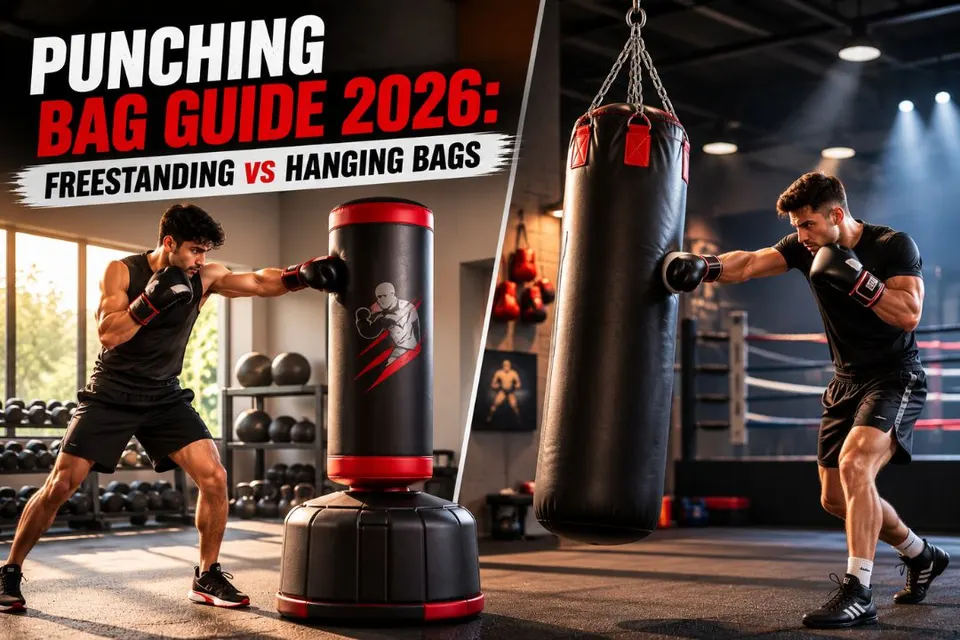
A punching bag is often the first serious equipment purchase a boxing beginner makes after gloves — and it's also where most people get stuck. Should you buy a freestanding bag or a hanging one? What weight actually makes sense for your body size? Does a smaller apartment rule out a proper heavy bag setup entirely?
The honest answer is that the "best" punching bag depends entirely on your living situation, training goals, and how seriously you plan to train. This guide walks through the real trade-offs between freestanding and hanging bags, how to choose the right weight, and what actually matters for home-gym setups in Indian apartments and houses.
The most common mistake isn't choosing the wrong bag type — it's not accounting for where the bag will actually live. A hanging heavy bag needs a mounting point rated for significant swinging force (ceiling joist, wall bracket, or dedicated stand), and many buyers only discover this after the bag arrives. A freestanding bag needs floor space and a stable base, but skips the installation problem entirely.
Getting this decision right before you buy saves you from either an unusable bag sitting in a corner, or a mounting bracket that pulls out of a false ceiling six weeks into training.
A punching bag isn't just a fitness prop — it's the primary tool for developing power, timing, and combination work outside of pad sessions with a partner. Inconsistent bag movement (from a poorly anchored bag) teaches bad habits, because your body compensates for an unstable target instead of focusing on clean technique.
Weight matters just as much. A bag that's too light for your punching power will swing wildly and absorb less of your impact, transferring more shock back into your wrists and shoulders — even with good gloves and wraps.
Freestanding bags sit on a weighted (usually water- or sand-filled) base, with no mounting or drilling required.
Pros:
● No installation — set it up and start training within minutes
● Easy to relocate within a room, or move entirely if you shift homes
● No risk to ceiling or wall structure, which matters in rented apartments
● Adjustable height on most models, useful if multiple people in the household train
Cons:
● Generally lighter overall resistance than a hanging bag of similar size, since the base can tip or slide under a hard punch
● The base takes up significant floor footprint even when not in use
● Tends to wear out faster at the base swivel joint with heavy daily use
Hanging bags are suspended via chain or strap from a fixed mounting point — ceiling, wall bracket, or a dedicated hanging stand.
Pros:
● More stable and realistic resistance — closer to what you'd feel training at a boxing gym
● Higher weight capacity, better suited for power training and heavier-framed trainees
● Doesn't occupy floor space once properly mounted
Cons:
● Requires either a structurally sound ceiling point or a separate wall-mounted/floor stand — a real constraint in most Indian apartments with false ceilings
● Installation isn't something most people can safely DIY without checking load-bearing points
● Not portable once mounted
Bag weight should roughly correspond to your body weight for balanced resistance:
● Under 50kg bodyweight: 15–20kg bag
● 50–70kg bodyweight: 25–35kg bag
● 70–90kg bodyweight: 35–45kg bag
● 90kg+ bodyweight: 45kg+ bag, ideally hanging rather than freestanding for stability
A bag that's too heavy for your weight and power level won't move enough to teach proper follow-through, while a bag that's too light will swing excessively and disrupt combination work.
It's worth understanding these aren't interchangeable — they train different skills:
Heavy bag: Power, combinations, conditioning. The default choice for most home setups and the right starting point for beginners.
Speed bag: Hand-eye coordination and rhythm, mounted on a small platform. Best added once basic technique on the heavy bag is established — not a beginner's first purchase.
Double-end bag: Suspended between floor and ceiling anchors with elastic cords, used for reflex and accuracy training. More advanced and space-demanding; typically a second or third purchase for serious trainees.
For most people building a first home boxing setup, a heavy bag (freestanding or hanging, based on your space) covers 90% of training needs.
● Measure your ceiling height and available floor space before choosing. A hanging bag typically needs at least 7 feet of clearance from mount point to bag base for full-swing training.
● Check the fill type on freestanding bases. Water-filled bases are lighter to transport before filling (useful if you're moving it up stairs) but can develop leaks over years of use. Sand-filled bases are heavier and more stable but harder to relocate once filled.
● Don't skip the mounting hardware inspection. If going hanging, get the ceiling or wall bracket professionally checked for load capacity — a heavy bag under full punching force generates significant dynamic load, well beyond its static weight.
● Budget for gloves and wraps in the same purchase. A punching bag without proper hand protection is one of the fastest ways to injure knuckles and wrists, especially in the first few weeks before technique develops.
Situation | Recommended Bag Type |
Rented apartment, no drilling allowed | Freestanding |
Own home with accessible ceiling joist | Hanging |
Frequently rearranging home gym space | Freestanding |
Serious power training, heavier build | Hanging (higher stability) |
Shared household, multiple users, varying heights | Freestanding (height-adjustable) |
Limited floor space, high ceiling available | Hanging |
There's no universally "better" punching bag type — only the one that fits your space, your training goals, and your living situation. Freestanding bags win on flexibility and zero-installation convenience, which suits most apartment dwellers and casual trainees. Hanging bags win on stability and realism, better suited to those with a dedicated space and serious power-training goals. Match the bag to your actual setup rather than what looks best online, and you'll get years of consistent use out of it.
Browse punching bags, gloves, and complete boxing training setups at SportsGear24x7 — freestanding and hanging options available with weight guidance for every body type.
Q1. Is a freestanding or hanging punching bag better for beginners?
Freestanding bags are generally better for beginners, especially in apartments, because they need no installation and can be adjusted or moved easily as you figure out your training routine.
Q2. What weight punching bag should I buy for home use?
Match the bag weight to roughly 40–50% of your body weight as a starting point — for example, a 70kg person should look at a 30–35kg bag.
Q3. Can a freestanding punching bag handle serious power training?
To an extent, but heavier punchers will find freestanding bags tip or slide under hard shots. If power development is your main goal, a properly mounted hanging bag offers more stable resistance.
Q4. How much ceiling clearance do I need for a hanging bag?
Aim for at least 7 feet from the mounting point to the bottom of the bag, giving enough room for the bag to swing and for you to throw full-extension punches safely.
Q5. Do I need gloves for a heavy bag, or can I use wraps alone?
Always use gloves for bag work, not just wraps. Wraps alone don't provide enough cushioning against repeated heavy-bag impact and significantly increase the risk of knuckle and wrist injury over time.
The SportsGear24x7 Editorial Team is a group of passionate cricket enthusiasts and equipment specialists based in New Delhi, India. With over a decade of experience in the cricket gear industry, our team has helped thousands of players — from beginners to state-level competitors — find the right equipment for their game. Every article we publish is backed by real product knowledge, on-ground player feedback, and deep understanding of the Indian cricket ecosystem.