Is T20 Cricket Slowly Reducing the Importance of Test Cricket — or Is It Actually Helping It?
Updated 4 min read


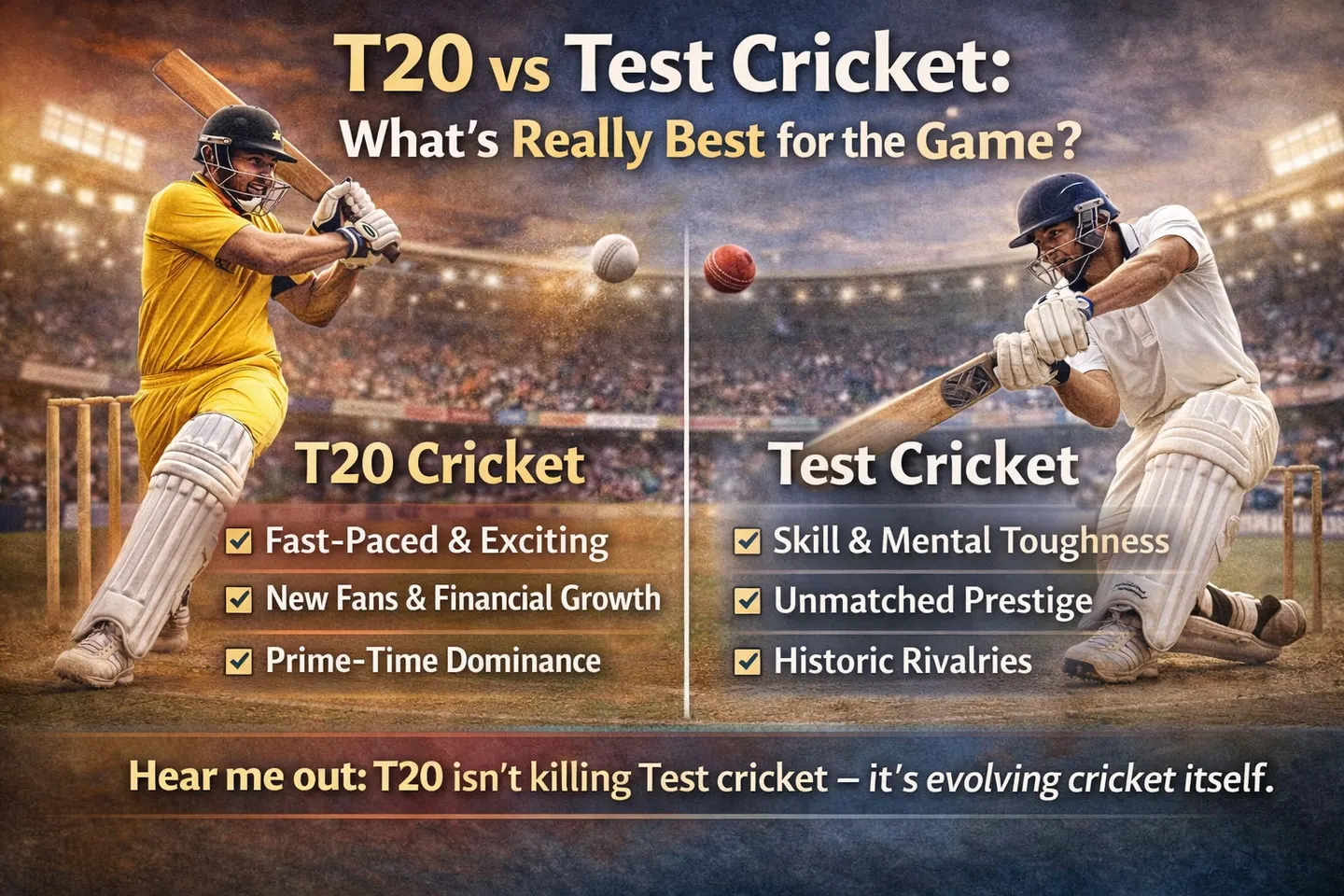
This is one of the biggest “hear me out” debates in modern cricket.
On one side, fans argue that T20 cricket has shortened attention spans, pulled players away from Test cricket, and turned the game into pure entertainment.
On the other, many believe T20 has saved cricket, brought new audiences, and even strengthened the longer formats.
So what’s the truth?
Let’s break it down — honestly, practically, and without nostalgia bias.
T20 cricket didn’t just change match duration — it changed how cricket is consumed.
With leagues like the Indian Premier League, cricket became:
Faster
More accessible
Prime-time entertainment
For younger fans, T20 is often the entry point into cricket. Many didn’t fall in love with the game through five-day Tests — they discovered it through sixes, yorkers, and packed stadiums.
Hear me out: Without T20, many modern fans might never have watched cricket at all.
At first glance, it does feel that way.
Fewer Test matches for some nations
Empty stadiums in certain countries
Players prioritising franchise cricket
But importance isn’t only about popularity — it’s about prestige.
Test cricket still:
Defines technical excellence
Tests mental toughness
Separates great players from good ones
Winning a Test series overseas still carries a respect that no T20 trophy can replace.
Hear me out: Test cricket hasn’t become less important — it has become more exclusive.
This might sound controversial, but stay with me.
Financial Stability Keeps Test Cricket Alive
Revenue from T20 leagues funds:
Domestic cricket
Stadium infrastructure
Player contracts
Without T20 money, many boards would struggle to host long Test series.
Better Athletes, Better Fielding
Modern cricketers are:
Fitter
Faster
More athletic
T20 has raised fitness standards, and Test cricket has benefitted from sharper fielding and quicker reflexes.
Fearless Batting Has Improved Tests
Thanks to T20:
Players attack more confidently
Run rates have increased
Draws are less common
Modern Test matches are often more result-oriented and exciting than before.
Hear me out: T20 didn’t ruin Test batting — it made it more positive.
Let’s be fair — it’s not all perfect.
Player Burnout
Year-round T20 leagues leave players exhausted, increasing injuries and forcing tough format choices.
Shortened Patience
Some young players struggle with:
Long spells of defense
Batting for sessions
Bowling long spells
Test cricket demands skills T20 alone can’t teach.
Instead of fighting over which format is “better,” it helps to see cricket as one game with three personalities:
Test Cricket – Character, patience, legacy
ODIs – Balance, strategy, adaptability
T20s – Entertainment, innovation, reach
Each format feeds the other.
Hear me out: Cricket isn’t being divided — it’s being diversified.
If you’re an aspiring player:
T20 can open doors and opportunities
Test cricket builds long-term skill and respect
The smartest players don’t choose one — they prepare for all formats.
Solid defense, fitness, technique, and game awareness still matter — regardless of format.
Hear me out one last time:
T20 cricket is not killing Test cricket.
It’s changing how we arrive at it.
T20 brings fans in.
Test cricket keeps purists loyal.
As long as boards, players, and fans respect the value of all formats, cricket doesn’t lose its soul — it evolves.
Your turn:
Do you think T20 has gone too far, or has it made cricket stronger than ever?
And if you’re gearing up to play — whether Tests-style patience or T20 aggression — choosing the right bat, helmet, and protective gear matters in every format.
Play smart. Respect the game. Enjoy every format.
T20 cricket attracts larger audiences, but Test cricket still holds unmatched prestige and respect. Popularity and importance are not the same.
Yes. T20 has encouraged more positive batting, improved fitness, and made Test matches more result-oriented and engaging.
Some players prioritise T20 leagues due to financial security and workload management, but many still value Test cricket as the ultimate format.
Absolutely. Revenue from T20 leagues supports cricket boards and helps sustain Test cricket, especially in countries with limited resources.
Young players should build strong fundamentals through longer formats while using T20 to develop fitness, confidence, and adaptability.
The SportsGear24x7 Editorial Team is a group of passionate cricket enthusiasts and equipment specialists based in New Delhi, India. With over a decade of experience in the cricket gear industry, our team has helped thousands of players — from beginners to state-level competitors — find the right equipment for their game. Every article we publish is backed by real product knowledge, on-ground player feedback, and deep understanding of the Indian cricket ecosystem.