How Wrong Cricket Shoes Cause Foot Pain and Injuries — And Why the ID1 by Idoneus Sports Was Built to Fix This
Updated 8 min read


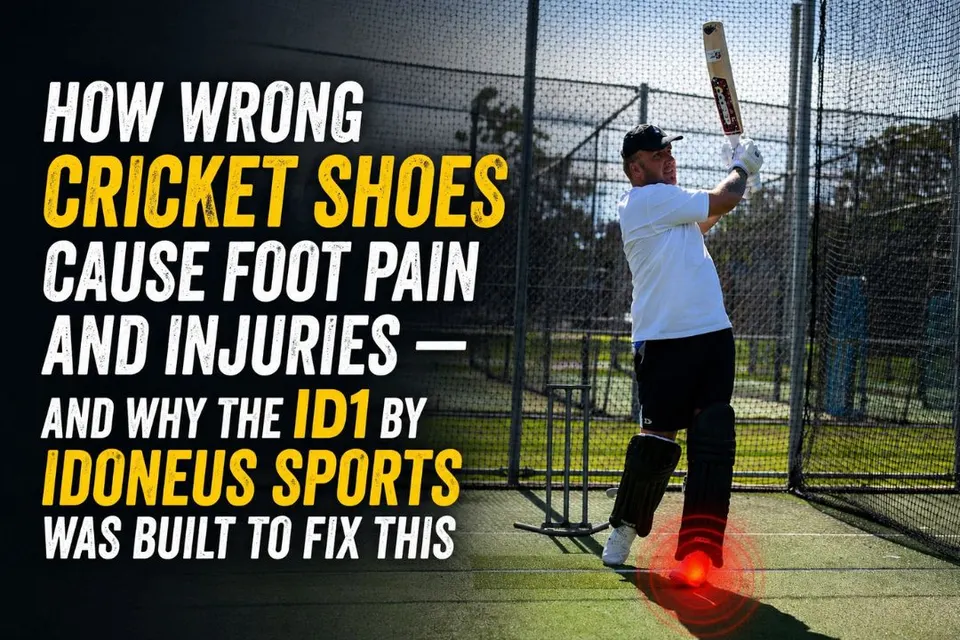
There is a persistent myth in cricket that injuries happen from bad luck — a ball that jagged unexpectedly, a fielding dive gone wrong, a delivery that hit the body at the wrong angle. While those moments exist, the data tells a different story. A significant portion of cricket injuries are not from one-off incidents. They are the slow, accumulated consequence of players putting their feet into the wrong shoes, day after day, season after season.
Sore feet after the first session. Knee ache that lingers into the next morning. Hip stiffness that never quite goes away. These are not signs of age or bad luck — they are signs of footwear failure, and they are preventable. The ID1 by Idoneus Sports was designed specifically because the founders of Idoneus were cricketers who experienced this failure firsthand, working with podiatrists and exercise physiologists to build a shoe that addresses the root cause.
The relationship between cricket footwear and injury is not anecdotal — it is documented and measurable:
38% of cricket injuries are footwear-related | 8× body weight force on delivery stride | 41% injury reduction with proper footwear |
These numbers mean that nearly 4 in every 10 cricket injuries could be prevented or reduced with better footwear choices. A 41% reduction in injury risk is not a marginal gain — it is a transformational change in how long a player can stay healthy, active, and competitive.
Plantar fasciitis is inflammation of the thick band of tissue connecting the heel to the toes along the bottom of the foot. It produces a stabbing heel pain — worst on first steps in the morning or after long periods of standing. In cricket, it is extremely common in fielders, wicket keepers, and batting sides who spend extended periods on their feet. The primary cause in footwear: inadequate arch support and insufficient heel cushioning that fails under prolonged load.
Shin splints develop from repetitive impact on the lower leg — common in fast bowlers during long spells and batsmen running extensive net sessions. Poor shock absorption in the shoe midsole allows ground impact to travel directly up into the shin and tibia, creating micro-stress that accumulates over time. A shoe with proper multi-density cushioning intercepts this energy before it reaches the bone.
The knee is directly affected by what happens at the foot. When a shoe does not provide adequate lateral stability — or when the toe box is too narrow — the resulting misalignment travels up the kinetic chain to the knee joint. Over a full cricket season, this cumulative misalignment causes patellofemoral pain syndrome — a grinding, aching discomfort around the kneecap that worsens with activity.
Foot mechanics directly influence hip alignment. A shoe that allows excessive pronation causes the hip to compensate with an altered gait pattern. Across a long season, this compensation results in hip flexor tightness, lower back pain, and — in severe cases — referred pain that mimics a hamstring injury. Cricketers who suffer from unexplained lower back pain after long days on the field are frequently experiencing the downstream consequence of poor footwear.
Cricket involves constant lateral movement — fielders sprinting to cut off a ball, batsmen driving across the crease, bowlers landing in their delivery stride. Without proper heel lock and lateral support, the ankle rolls under load — causing sprains that range from mild to career-affecting. A shoe with an ankle strap and firm heel counter holds the foot in neutral alignment, significantly reducing sprain risk.
THE CHAIN REACTION |
Poor footwear → foot strike misalignment → knee compensation → hip misalignment → lower back pain. Every cricket injury you experience 'above the ankle' may have started below it. This is the biomechanical chain that 45+ years of podiatry expertise taught the team behind the ID1 by Idoneus Sports. |
To understand how these injuries specifically affect different player positions, read our guide on how batsmen benefit from proper cricket shoe support during shot-making and long innings — and how shoe choice directly impacts batting performance as well as physical health.
The fundamental problem is that most cricket shoes are not designed from scratch for cricket. They are running shoe or tennis shoe platforms with cricket-specific outsoles bolted on. The cushioning systems, heel geometry, toe box dimensions, and midsole density are borrowed from other sports — sports that do not involve 8 hours of fielding, multi-hour batting innings, or the unique rotational forces of a fast bowling delivery stride.
Generic 'cushioning technology' in mass-market cricket shoes typically involves a single-density EVA foam — comfortable initially, flat and compressed within a few sessions. It does nothing to distribute load across the foot, protect the plantar fascia, or maintain the heel stability needed across a long day.
The podiatrist-designed ID1 cricket shoe was built with injury prevention as its founding principle. Every feature exists because 45+ years of podiatry experience and Masters-level clinical exercise physiology identified it as essential:
• Multi-density cushioning system: Unlike single-density foam, the ID1 uses layered cushioning that remains effective across extended play — reducing cumulative impact load on the plantar fascia, shins, and knees session after session.
• Wide toe box: Allows natural toe splay, reducing the compression forces that lead to bunions, neuromas, and forefoot pain in cricketers who play regularly.
• Ankle strap heel lock: Maintains the heel in a neutral, stable position through every movement pattern cricket demands — preventing the lateral roll that causes ankle sprains and the upstream misalignment that causes knee and hip pain.
• All-surface outsole: Consistent grip across Indian pitch surfaces eliminates compensatory gait patterns that players develop when their shoe slips — patterns that are themselves a significant source of injury.
Wicket keepers deserve special mention here — wicket keepers face some of the highest footwear-related injury risk of any player position, given the sustained squat load and explosive lateral movements their role demands across an entire innings.
• Heel pain in the morning: after play days — a classic early sign of developing plantar fasciitis.
• Shin soreness that persists 48 hours: after a bowling or fielding session — suggests inadequate shock absorption in the midsole.
• Knee ache after long sessions: that was not present two seasons ago — often footwear-related misalignment building over time.
• Visible sole compression: when you press the midsole with your thumb — if the foam does not spring back, it is no longer absorbing impact.
• Foot movement inside the shoe: during batting or running — the heel counter has collapsed and the shoe no longer provides structural support.
Feature | Injury It Prevents | Standard Shoe | ID1 by Idoneus |
Multi-density cushioning | Plantar fasciitis, shin splints | ✗ Single-density EVA | ✓ Multi-layer system |
Wide toe box | Neuromas, bunions, forefoot pain | ✗ Narrow / standard | ✓ Designed wide |
Ankle strap heel lock | Ankle sprains, knee misalignment | ✗ Basic heel counter | ✓ Full ankle strap |
All-surface grip | Compensatory gait injuries | ✗ Grass-optimised only | ✓ Turf, matting & hard ground |
Podiatry-backed design | Long-term foot health | ✗ Generic engineering | ✓ 45+ years expertise |
The fastest way to extend your playing career is to protect your feet. Nearly 4 in 10 cricket injuries are footwear-related — that means they were preventable. The ID1 by Idoneus Sports — try it risk-free with a 30-day guarantee — is the only cricket shoe in India backed by genuine podiatry science built specifically to break the cycle of footwear-caused cricket injuries. For players who want to play longer, stay healthier, and perform better, the answer begins at the sole of the shoe.
Q: Can cricket shoes really cause plantar fasciitis?
Yes. Plantar fasciitis is among the most common overuse injuries in cricket and is strongly linked to inadequate footwear. Shoes that lack proper arch support and heel cushioning place excessive stress on the plantar fascia — especially during long fielding sessions or extended batting innings. Switching to properly cushioned, arch-supporting footwear is one of the most effective interventions.
Q: How does a shoe cause knee pain?
Poor foot mechanics caused by an ill-fitting shoe alter the way force travels up the kinetic chain from the foot through the ankle to the knee. Excessive pronation, heel instability, or a narrow toe box all change natural gait patterns in ways that place abnormal stress on the knee joint. Over time, this cumulative misalignment causes patellofemoral pain and other chronic knee conditions.
Q: What makes the ID1 different from other cricket shoes in injury prevention?
The ID1 by Idoneus Sports is designed from the ground up with injury prevention as the primary objective — using 45+ years of podiatry expertise and clinical exercise physiology. It features multi-density cushioning, a wide toe box for natural foot mechanics, and an ankle strap heel lock for lateral stability. No standard cricket shoe sold in India offers this combination of features backed by clinical science.
Q: How do I know if my current cricket shoes are causing my foot pain?
Key signs include heel pain on first steps after match days, shin soreness persisting more than 48 hours, knee ache during or after long sessions, and visible midsole compression that does not spring back. If your foot moves inside the shoe during play, the heel counter has collapsed — a significant injury risk that requires immediate shoe replacement.
Q: Is the 30-day guarantee on the ID1 genuine?
Yes. Idoneus Sports offers a 30-day satisfaction guarantee. If the ID1 does not feel right or does not solve your foot comfort issues within 30 days, unused items can be returned for a full refund. This reflects the confidence Idoneus has in what their podiatry-designed shoe delivers.
The SportsGear24x7 Editorial Team is a group of passionate cricket enthusiasts and equipment specialists based in New Delhi, India. With over a decade of experience in the cricket gear industry, our team has helped thousands of players — from beginners to state-level competitors — find the right equipment for their game. Every article we publish is backed by real product knowledge, on-ground player feedback, and deep understanding of the Indian cricket ecosystem.