How to Choose a Cricket Bat — Complete Selector Guide by Playing Style, Level & Budget
Updated 5 min read


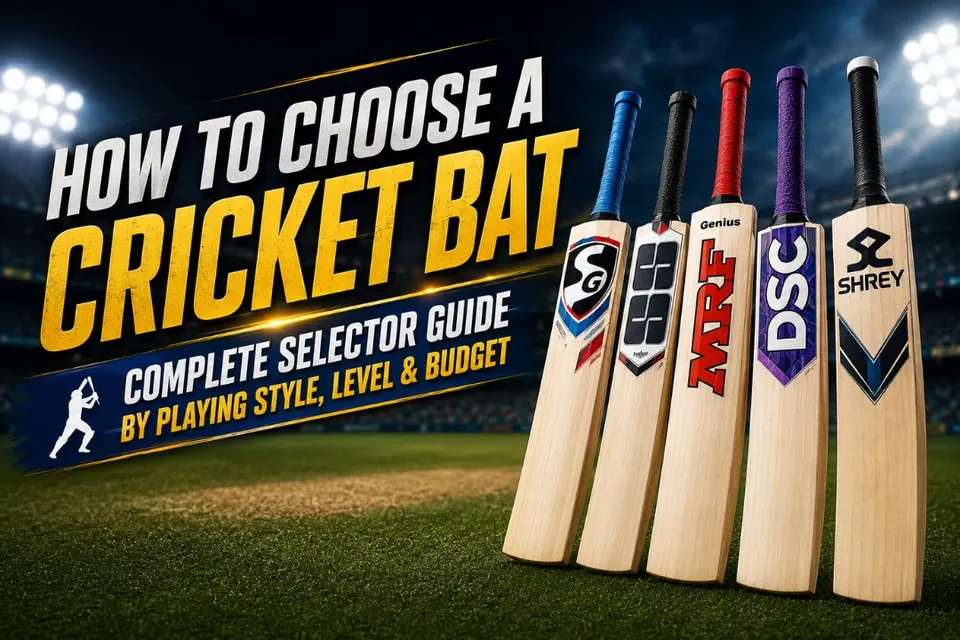
Walk into any cricket equipment store and the choice is overwhelming. Kashmir willow, English willow, Grade 1, high sweet spot, short handle — the jargon alone is enough to send a new cricketer home empty-handed. And experienced players are not immune: many club cricketers have bought bats completely wrong for their game and never understood why their shots never felt quite right. This complete cricket bat selector guide simplifies the entire decision into a logical, five-step process.
A bat that is too heavy slows your backlift and reduces shot-making speed. A bat with the sweet spot in the wrong position makes even well-timed shots feel dull on impact. The wrong bat does not just underperform — it actively creates bad habits that take months to unlearn. The best cricket bat for you is not the most expensive one. It is the one that matches your technique, your playing format, and the surfaces you play on.
If you are new to cricket or playing at school level, prioritise durability and affordability. You are still developing your technique, which means the bat will take more mistimed shots than clean middle-of-the-bat strikes. A Kashmir willow bat is the right starting point. Read our detailed Kashmir willow vs English willow guide to understand exactly when to make the switch. Recommended bats: DSC Condor, SS Sky Smasher, SG Savage Plus, MRF Titan Player Edition.
If you are playing regular leather ball cricket with a consistent technique, English willow is the right investment. Look for Grade 3 or Grade 4 English willow — genuine performance without the premium price of Grade 1. Recommended: SG KLR Blitz, SF Almandus Proface, SS Gladiator, MRF Chase Master.
Grade 1 or Grade 2 English willow for players competing at district, state, or professional levels. Do not compromise at this stage — the willow grade, blade geometry, and pickup consistency directly affect performance. Recommended: MRF Genius Grand, SF Pro Blaster 8000, SS Ton Reserve Edition.
Classical batters who play through the V and drive through the off side need a bat with a mid sweet spot. This position rewards drives and cut shots with maximum power while maintaining balance for defensive shots. Best picks: MRF Chase Master, SG KLR Blitz.
Modern aggressive batters who rely on pull shots, sweeps, and lofted drives need a bat with a high sweet spot — thick spine and high swell that generates power on balls angled into the body or on short-pitched deliveries. Best picks: SF Pro Blaster, SS Ton Aggressive Player, MRF Genius Grand. See our SF cricket bats review 2026 for a full breakdown of the SF Pro Blaster series.
An all-rounder needs a mid-to-high sweet spot with balanced edges, typically between 1.15 kg and 1.25 kg pickup weight — versatile enough to defend in tough conditions and attack when the game opens up.
Short Handle (SH): Standard adult handle. Suits most players up to 185 cm.
Long Handle (LH): Extended handle for taller players (185 cm+) who prefer more reach on the drive.
Short Long Handle (SLH): Hybrid option — slightly extended without the full LH length.
Hold the bat in your batting grip and lift it into your backlift position. If your top wrist is straining at the end of the backlift, the bat is too heavy. Most adult male cricketers find their ideal pickup between 1.1 kg and 1.3 kg. Women and junior cricketers typically use 0.9 kg–1.1 kg.
Budget | What to Buy | Recommended |
|---|---|---|
Under ₹1,500 | Kashmir willow, entry-level | DSC Condor, SG Savage, MRF Champion |
₹1,500–₹3,500 | Kashmir willow, premium | SS VA900, MRF Titan, SF Classic |
₹3,500–₹7,000 | English willow, Grade 3–4 | SG KLR, SF Almandus, SS Gladiator |
₹7,000–₹14,000 | English willow, Grade 2 | MRF Chase Master, SF Pro Blaster 8000 |
₹14,000+ | English willow, Grade 1 | MRF Genius Grand, SF Gradiges 9000 |
Browse the complete range of cricket bats at SportsGear24x7 and use the brand and willow-type filters to narrow your selection.
According to the International Cricket Council (ICC) Equipment and Playing Conditions guidelines, a cricket bat blade must be made of wood, with strict regulations on dimensions at professional levels — though willow type is not mandated.
Choosing the right cricket bat is a five-step process: assess your level, match the bat to your playing style, select your handle type, find the right pickup weight, and set a realistic budget. Browse all cricket bats at SportsGear24x7 to find your ideal match.
Q1. How do I know what size cricket bat I need?
For adults, the Short Handle (SH) bat is the standard. Junior bat sizes (1–6) are determined by the player's height. Use the size chart available at SportsGear24x7 to match height to bat size accurately.
Q2. Should a beginner buy Kashmir willow or English willow?
A beginner should always start with Kashmir willow. It is more durable, more affordable, and does not require the careful preparation that English willow demands. Upgrade once your technique is consistent.
Q3. What weight cricket bat should I use?
Most adult male cricketers use bats between 1.1 kg and 1.3 kg. Test the pickup in your batting stance — if the wrist strains at the top of the backlift, the bat is too heavy.
Q4. How do I know if a cricket bat has the right sweet spot for me?
Top-order batters who drive and cut → mid sweet spot. Aggressive T20 players who pull and sweep → high sweet spot. All-format players → mid-to-high sweet spot.
Q5. How long does a good cricket bat last?
A well-maintained English willow bat lasts 2–5 seasons with proper knocking-in, oiling, and storage. Kashmir willow bats typically last 2–3 seasons before performance noticeably declines.
The SportsGear24x7 Editorial Team is a group of passionate cricket enthusiasts and equipment specialists based in New Delhi, India. With over a decade of experience in the cricket gear industry, our team has helped thousands of players — from beginners to state-level competitors — find the right equipment for their game. Every article we publish is backed by real product knowledge, on-ground player feedback, and deep understanding of the Indian cricket ecosystem.