Grade 1 vs Grade 2 vs Grade 3 English Willow Cricket Bat — What's the Difference?
Updated 5 min read


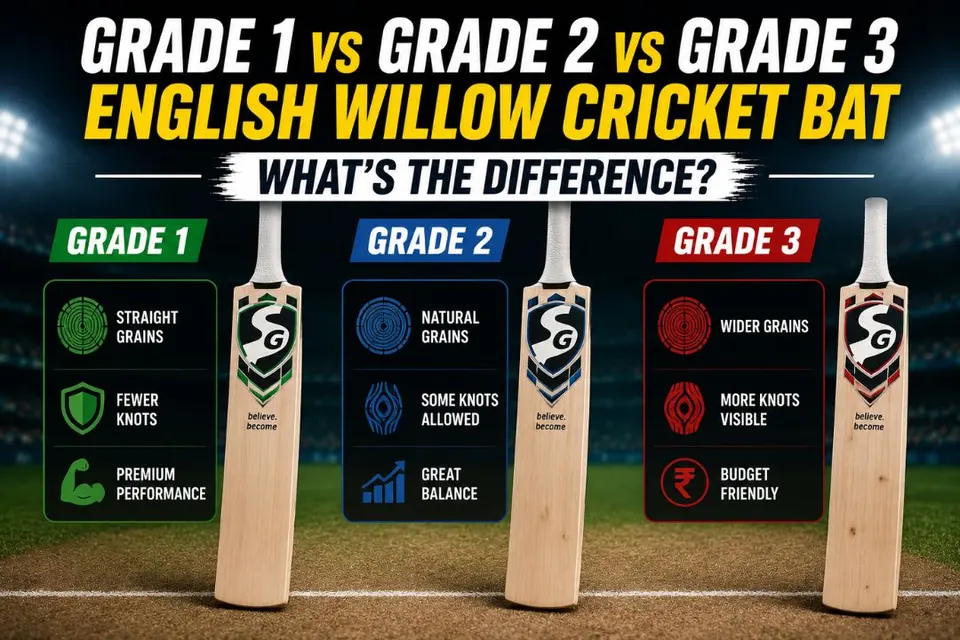
You have decided to buy an English willow cricket bat. Then you see the grade labels — Grade 1, Grade 2, Grade 3, Grade 4, Grade 5 — and realise you have no idea what any of them mean. Is Grade 1 always better? Is Grade 3 worth buying at all? Does the grade affect performance or just appearance? These are questions even experienced club cricketers struggle to answer confidently. This guide explains exactly what English willow grades mean, how they affect performance and price, and which grade is right for your level of play.
English willow grading is primarily a classification system based on the visual quality of the willow — not exclusively the performance. The grades assess three things:
• Number and straightness of grains: Grain lines are the vertical markings visible on the face of the bat. More grains running perfectly straight from top to bottom indicate better quality, more evenly grown willow that typically performs better.
• Colour of the willow: Premium English willow has a clean white or very pale cream colour. Reddish tints, brown streaks, and blemishes indicate either the bat was cut from the outer part of the tree (less desirable) or the willow has natural imperfections.
• Presence of blemishes, butterfly stains, and knots: Butterfly stains and small knots are natural features of willow. They are cosmetic in nature and do not affect bat performance — but they affect the grade and therefore the price.
This is the most important thing most buyers do not understand: a bat with butterfly stains or slight discolouration performs identically to a cosmetically perfect bat of the same weight and profile. The grade only affects appearance and price, not the wood's fundamental quality. Before choosing your grade, make sure you have already decided between English willow and Kashmir willow — our Kashmir willow vs English willow guide explains when to make the switch.
6+ straight, evenly spaced grains. Pure white or very pale cream colour. No blemishes — cosmetically perfect. Highest-performing willow, lightest pickup for given weight, best power transmission. Grade 1 is what professional cricketers use. For a club cricketer, the performance advantage over Grade 2 is real but marginal in practice. Price range: ₹12,000–₹30,000+.
5–7 straight grains. White to pale cream, possibly with minor discolouration. Very minor blemishes. The sweet spot for serious club and district-level cricketers — the performance difference versus Grade 1 is minimal in real-world conditions. Grade 2 bats offer the same fundamental willow quality as Grade 1 with minor cosmetic differences that do not affect how the bat plays. Price range: ₹7,000–₹15,000.
4–6 grains, may not be perfectly straight. Light cream, possible minor reddish tints or streaks. May have small butterfly stains. The most popular English willow grade in India for club cricketers. Minor visual imperfections do not reduce bat performance in practice. If you are playing regular leather ball cricket at club level and want to upgrade to genuine English willow, Grade 3 is the ideal entry point. Price range: ₹3,500–₹8,000.
3–5 grains, may be slightly irregular. Cream with more noticeable discolouration. Visible butterfly stains. The bat still offers the fundamental performance advantages of EW over Kashmir willow. Ideal if you are making the transition from Kashmir willow and want to understand how English willow feels before investing in a Grade 2 or 3. Price range: ₹2,500–₹5,000.
Player Level | Recommended Grade | Reason |
First English willow bat | Grade 4 | Learn EW without large investment |
Regular club cricketer | Grade 3 | Best value, genuine EW performance |
Competitive / district level | Grade 2 | Close to professional quality |
State / professional level | Grade 1 | Maximum performance, no compromise |
When comparing brands within each grade, our MRF cricket bats complete guide 2026 covers how MRF grades their English willow range and which MRF model maps to each playing level.
According to Wisden Cricket's equipment guide, the grading of English willow is an industry convention rather than a universally standardised system — grades can sometimes vary slightly between manufacturers. Always buy from trusted brands and verify the grade description on the product listing.
Explore the complete cricket bat range at SportsGear24x7 with grade filters to find the right English willow bat for your game and budget.
English willow grades are primarily cosmetic classifications — Grades 3 and 4 perform excellently at club level despite costing a fraction of Grade 1. Buy the grade that matches your playing level and budget, not the highest grade you can afford. Browse all cricket bats at SportsGear24x7 to find your perfect English willow match.
Q1. Does a higher cricket bat grade mean better performance?
Not necessarily. Grade 1 offers the best cosmetics and potentially the lightest pickup, but Grades 2 and 3 perform comparably for club-level cricketers. The performance difference between Grade 1 and Grade 3 is minimal in practice conditions.
Q2. What grade of English willow should a club cricketer buy?
Grade 3 English willow is the ideal choice for most club cricketers. It offers genuine English willow performance at an accessible price point with minor cosmetic imperfections that have no impact on how the bat plays.
Q3. What is the price difference between Grade 1 and Grade 3 English willow?
Grade 1 English willow bats typically cost ₹12,000–₹30,000+. Grade 3 bats cost ₹3,500–₹8,000. The performance gap between the two does not justify the price gap for most club-level players.
Q4. Are butterfly stains on a cricket bat a defect?
No. Butterfly stains are a natural feature of willow wood — cosmetic only with no effect on bat performance. Bats with butterfly stains are sold at lower grades and lower prices despite performing identically to cosmetically clean bats.
Q5. How many grains should a good cricket bat have?
A Grade 1 bat has 6+ straight grains. Grade 2 has 5–7 grains. Grade 3 has 4–6 grains. More grains generally indicate better quality willow — but grain count alone does not determine performance. Blade geometry, weight distribution, and pressing also play important roles.
The SportsGear24x7 Editorial Team is a group of passionate cricket enthusiasts and equipment specialists based in New Delhi, India. With over a decade of experience in the cricket gear industry, our team has helped thousands of players — from beginners to state-level competitors — find the right equipment for their game. Every article we publish is backed by real product knowledge, on-ground player feedback, and deep understanding of the Indian cricket ecosystem.