Cricket Sunglasses & Eyewear Guide: Why Polarized Lenses Matter for Batsmen and Fielders
Updated 5 min read


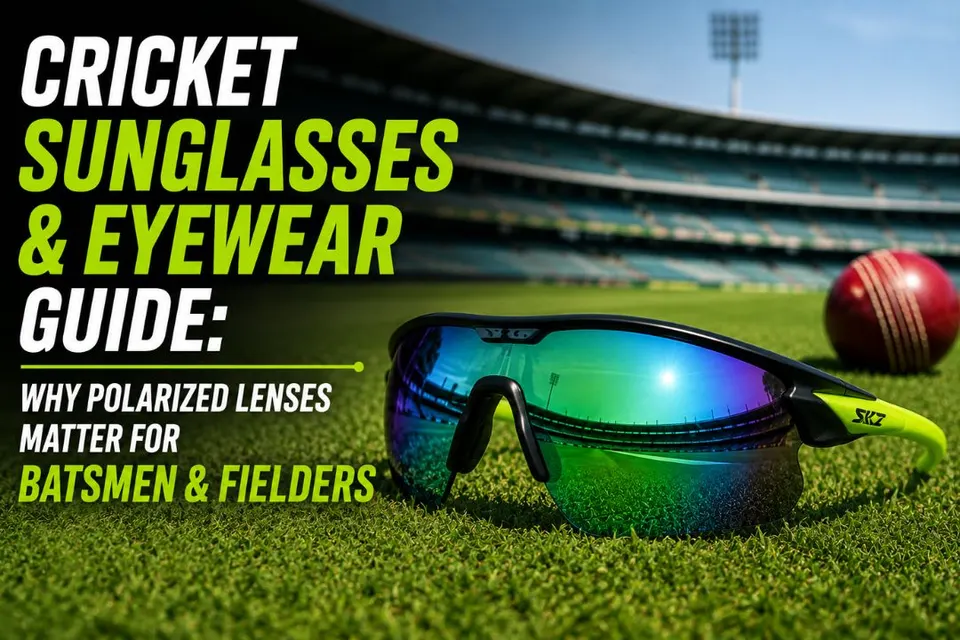
Cricket is played almost entirely outdoors, often across long afternoons under harsh sun — yet eyewear remains one of the most under-purchased items in a typical kit bag. Fielders lose skied catches in glare, batters squint through the release point of a bowler running in from a bright background, and years of unprotected sun exposure add up. Purpose-built cricket sunglasses solve a specific, recurring on-field problem that regular sunglasses often don’t.
Ask any fielder who has lost a catch skied straight into the sun what went wrong, and the answer is almost always the same: they simply couldn’t see the ball against the glare. This isn’t a skill issue — it’s an optics issue. Standard sunglasses reduce overall brightness but don’t necessarily cut the specific horizontal glare that comes off a bright sky, a light-coloured sightscreen, or a sun-drenched outfield.
Batters face a related but different problem: tracking a ball released from a bowler’s hand against bright, high-contrast backgrounds, where squinting fractionally delays picking up length and line.
Polarized lenses use a filter that blocks horizontally scattered light — the exact kind of glare that bounces off bright surfaces like a cricket outfield, a light sightscreen, or reflective advertising boards. This is different from simply darkened lenses, which reduce brightness uniformly but don’t selectively cut glare.
For cricket specifically, polarization helps in two situations:
• Fielding under a skied catch, where the ball is briefly lost against bright sky.
• Fielding at point or cover on a sunny day, where glare off the ground and boundary boards causes eye strain across a long session.
1. Genuine polarization, not just tinted lenses — cheap “sports sunglasses” often skip this feature entirely despite marketing claims.
2. UV protection rating. Full UV400 protection is essential for players spending entire seasons under strong sun — this is a long-term eye health issue, not just an on-field performance one.
3. Secure, lightweight fit. Sunglasses that slide down during a sprint to the boundary or a full-stretch dive are worse than useless — look for rubberised nose pads and temple grips designed for sport, not casual wear.
4. Impact-resistant lens material. Polycarbonate lenses resist shattering on impact — an important consideration given the sport involves a hard ball travelling at speed.
5. Anti-fog and anti-scratch coating. Long days in the field mean sweat, dust, and repeated handling — coatings extend the useful life of the lenses significantly.
• Fielders in catching positions, especially those regularly under skied deliveries (mid-off, mid-on, deep positions).
• Batters playing in bright, high-glare conditions, particularly against a light sightscreen or in coastal/high-altitude venues with intense sun.
• Umpires and long-format players who spend six-plus hours in direct sun across a single day.
• Junior players, whose eyes are more sensitive to prolonged UV exposure than adults’ — a habit worth building early.
The DSC Polarized Cricket Sunglasses – Passion and DSC Polarized Cricket Sunglasses – Glider both offer genuine polarization built specifically for outdoor sport use, with a secure fit designed to stay put through fielding movement.
If you’re building out your full on-field kit for sun protection and comfort, also consider the DSC Compression Arm Sleeve, which pairs well with eyewear as part of a complete sun-and-comfort setup for long days in the field.
Browse more options in our Cricket Accessories collection.
• Put sunglasses on before you take the field, not reactively once glare becomes a problem — your eyes adjust better with consistent light conditions from the start.
• Clean lenses with a proper microfibre cloth, not a shirt or towel, to avoid scratching the coating.
• Store in a hard case in your kit bag rather than loose, where lenses are easily scratched or bent out of shape.
• Don’t switch lenses mid-innings unless conditions genuinely change (e.g., cloud cover rolling in) — constant switching disrupts visual adjustment more than it helps.
Player Situation | Recommendation |
Regular catching positions (slip, gully, deep) | Polarized lenses, secure sport fit |
Batting in bright/high-glare venues | Polarized lenses with UV400 rating |
Junior player, general sun protection | Lightweight polarized sunglasses with UV protection |
Umpire / all-day exposure | Polarized, comfortable for extended wear |
Cricket sunglasses aren’t a vanity accessory — they solve a genuine, recurring on-field problem: glare that costs catches and undermines a batter’s ability to track the ball cleanly. A quality pair of polarized sunglasses is a small addition to your kit bag that pays off directly in dropped-catch prevention and long-term eye health.
Q: Are polarized sunglasses better than regular tinted sunglasses for cricket?
Yes, for cricket specifically. Polarization cuts horizontal glare — from bright sky, sightscreens, and outfield surfaces — in a way plain tinted lenses do not.
Q: Can wicketkeepers wear sunglasses while keeping?
Some keepers do, particularly when standing back in bright conditions, though many prefer a cap with a peak instead. It comes down to personal comfort and visibility preference.
Q: Do cricket sunglasses need to be different from regular sports sunglasses?
Cricket-specific eyewear is optimised for tracking a small, fast-moving ball against variable outdoor backgrounds, with a secure fit for sudden movement — features not always present in general-purpose sunglasses.
Q: How do I know if my sunglasses are genuinely polarized?
A simple test: look at a reflective surface like water or glass through the lenses and rotate them — polarized lenses will visibly reduce glare as you rotate; non-polarized lenses won’t show this effect.
The SportsGear24x7 Editorial Team is a group of passionate cricket enthusiasts and equipment specialists based in New Delhi, India. With over a decade of experience in the cricket gear industry, our team has helped thousands of players — from beginners to state-level competitors — find the right equipment for their game. Every article we publish is backed by real product knowledge, on-ground player feedback, and deep understanding of the Indian cricket ecosystem.