Cricket Kit Bag Buying Guide: Wheelie vs Duffle vs Backpack
Updated 8 min read


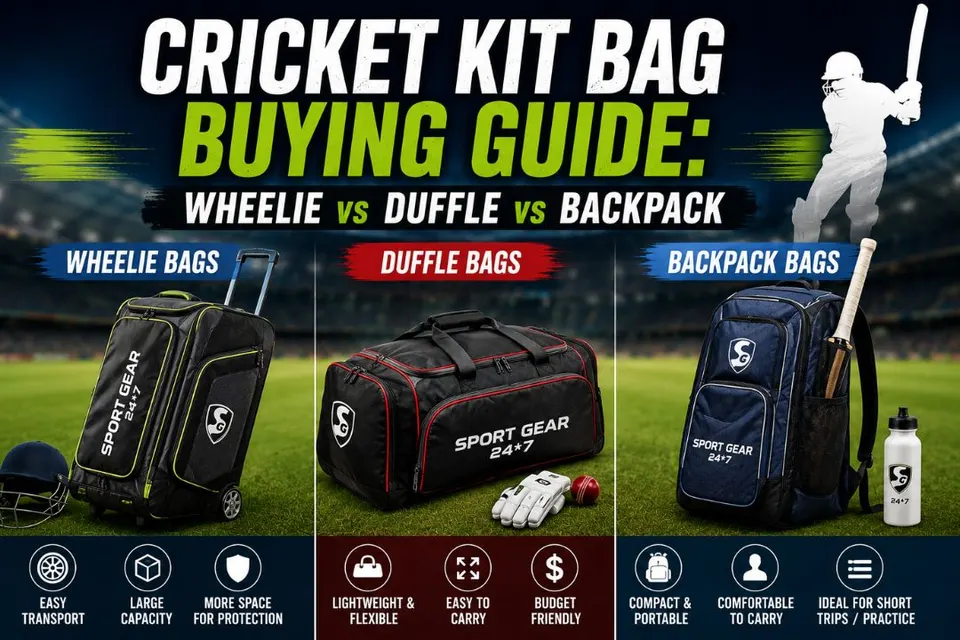
A cricket kit bag rarely gets the attention it deserves. Players will research a bat for weeks, compare five brands of batting gloves, and agonize over helmet certification — then grab whatever kit bag is cheapest or most available. But a poorly chosen kit bag doesn't just look disorganized. It shortens the lifespan of your bat, exposes pads and gloves to damp conditions, and turns match-day logistics into a genuine hassle.
This guide breaks down the real differences between wheelie, duffle, and backpack-style kit bags, and helps you choose based on how you actually travel to matches and training — not just what looks good in a product photo.
The most common kit bag mistake is buying the cheapest option available without checking capacity, compartment structure, or durability of the wheels and straps. A bag that's too small forces players to cram a bat in at an angle (a fast way to develop a warp or crack), while a bag with a flimsy wheel axle fails within a season of regular travel to away matches.
The second most common mistake is not matching the bag type to how you actually get to the ground. A wheelie bag is fantastic for parking-lot-to-pavilion convenience but becomes a genuine burden on uneven ground, stairs, or public transport — situations where a duffle or backpack style is far more practical.
Your kit bag is effectively a mobile storage unit for equipment that's expensive to replace and, in the case of your bat, sensitive to moisture and impact. A bag without a dedicated ventilated compartment for shoes means sweat and turf debris end up in direct contact with your gloves, pads, or clothing. A bag without a reinforced bat sleeve means your bat absorbs knocks during transport that have nothing to do with actual play.
Beyond protection, a well-organized kit bag also saves real time on match day — no digging through a single jumbled compartment looking for your abdominal guard five minutes before you're due to bat.
Wheelie bags — large duffle-style bags mounted on a wheeled base with a retractable handle — have become the standard choice for serious club and academy players.
Pros:
● Effortless to move once you're on flat ground — no strain carrying a fully loaded kit across a car park
● Generally the largest capacity option, fitting a complete kit including spare bat, full protective gear, and training accessories
● Reduces shoulder and back strain compared to carrying an equivalent duffle bag by hand
Cons:
● Wheels and axles are a genuine failure point — cheaper models often fail within a season of regular use on rough ground
● Bulky and difficult to manage on stairs, in narrow changing rooms, or on public transport
● Heaviest bag type even when empty, due to the wheel and frame structure
The traditional duffle-style bag — a large soft-sided bag carried by handles or a shoulder strap — remains popular for good reason.
Pros:
● Lighter empty weight than wheelie bags, easier to store when not in use
● More flexible in tight spaces — fits into car boots and changing room lockers more easily than a rigid wheelie frame
● Generally less expensive than an equivalent-capacity wheelie bag
Cons:
● Carrying a fully loaded duffle bag by hand or shoulder strap over any real distance gets uncomfortable fast
● No built-in mobility aid, so it's a poor choice if you're regularly walking significant distances to the ground
A newer but growing category, particularly popular with younger players and those relying on two-wheelers or public transport to get to matches.
Pros:
● Hands-free carrying distributes weight across both shoulders, more comfortable over longer walking distances
● Compact footprint compared to duffle or wheelie bags, easier to manage on crowded trains or buses
● Increasingly popular for junior players where bag weight relative to body size matters
Cons:
● Lower overall capacity — usually cannot fit a full adult kit including spare bat and complete protective gear
● Bat compartments in backpack-style bags are often external sleeves rather than fully protected internal compartments
A dedicated, padded bat sleeve. This is non-negotiable regardless of bag type. A bat resting loose against pads or shoes during transport is exposed to unnecessary knocks that can affect the blade's integrity over time.
Ventilated shoe compartment, separated from clothing and gloves. Cricket shoes — especially spiked ones — pick up moisture, mud, and turf debris. Without a separate, ventilated section, that moisture transfers directly to your other gear.
Reinforced stitching at stress points. Handle attachments, wheel mounts, and strap junctions are where cheap bags fail first. Reinforced double-stitching in these areas is a strong signal of overall build quality.
Weather resistance. Given India's monsoon season overlaps significantly with the domestic cricket calendar, a bag with at least water-resistant (not necessarily fully waterproof) exterior fabric is a genuinely practical feature, not a luxury add-on.
Junior and school-level players: A mid-sized backpack-style bag is often the most practical choice — lighter to carry, easier to manage independently, and appropriately sized for a junior kit that doesn't yet include a spare bat or extensive protective gear.
Club-level players traveling by car: A wheelie bag offers the best combination of capacity and convenience, since car-to-pavilion transport minimizes the wheelie bag's main weakness (rough terrain and stairs).
Players relying on public transport or two-wheelers: A duffle or backpack-style bag is more practical than a wheelie, since maneuvering a wheeled bag through crowded transport or on a two-wheeler is genuinely impractical.
Players who travel frequently for away matches or tournaments: A high-capacity wheelie bag with reinforced wheels justifies the investment here — the convenience compounds over repeated long-distance travel.
● Measure your longest bat (including any spares) before buying. Bat sleeves vary in length between brands, and a bag advertised as "full-size" doesn't always accommodate every bat length comfortably.
● Check wheel and axle material specifically if buying a wheelie bag. Reinforced plastic or metal axles significantly outlast basic plastic wheel mounts under regular use on rough grounds.
● Don't oversize unnecessarily. A bag significantly larger than your actual kit means gear shifts around loosely during transport, increasing wear and reducing organization.
● Look for external pockets for small accessories — bat grips, spare studs, and sunscreen are easy to lose in a single large compartment but stay accessible in a dedicated external pocket.
Your Situation | Recommended Bag Type |
Drive to matches, full adult kit | Wheelie |
Public transport or two-wheeler commute | Duffle or backpack |
Junior player, school cricket | Backpack |
Frequent away-match travel | High-capacity wheelie |
Tight storage space at home | Duffle (folds more compactly than wheelie frame) |
The right cricket kit bag isn't about the biggest capacity or the most premium price tag — it's about matching the bag to how you actually get to the ground and what your kit actually needs to carry. A wheelie bag rewards car-based convenience, a duffle bag rewards flexibility and lower cost, and a backpack rewards hands-free portability for lighter kits. Whichever type you choose, prioritize a padded bat sleeve, ventilated shoe storage, and reinforced stitching at stress points — these three features do more for your kit's longevity than any other spec on the bag.
Browse cricket kit bags at SportsGear24x7 — wheelie, duffle, and backpack styles from SG, SS, and DSC, sized for junior and adult kits.
Q1. Is a wheelie or duffle cricket kit bag better?
It depends on your travel method. Wheelie bags are better for car-based travel on flat ground; duffle bags are more practical for public transport, stairs, or uneven terrain where wheels become a hindrance.
Q2. What should I look for in a cricket kit bag for a beginner?
Focus on a padded bat sleeve, a separate ventilated shoe compartment, and a size appropriate for a beginner kit — you don't need maximum capacity if you're not yet carrying a spare bat or full protective gear.
Q3. How long do wheelie cricket kit bags typically last?
With regular club-level use, a well-built wheelie bag with reinforced wheels typically lasts 2–4 years. Cheaper models with basic plastic wheels often need wheel or axle replacement within a single season.
Q4. Can a backpack-style kit bag fit a full adult cricket kit?
Generally no — backpack-style bags suit lighter kits, particularly junior players. Adult players carrying a full kit including spare bat and complete protective gear usually need the extra capacity of a duffle or wheelie bag.
Q5. Is a water-resistant kit bag necessary in India?
Given that much of the domestic cricket season overlaps with monsoon conditions, at least basic water-resistant exterior fabric is a genuinely practical feature that protects your gear from unexpected rain during transport.
The SportsGear24x7 Editorial Team is a group of passionate cricket enthusiasts and equipment specialists based in New Delhi, India. With over a decade of experience in the cricket gear industry, our team has helped thousands of players — from beginners to state-level competitors — find the right equipment for their game. Every article we publish is backed by real product knowledge, on-ground player feedback, and deep understanding of the Indian cricket ecosystem.