Cricket Batting Pads for Fast and Bouncy Pitches — How to Choose the Right Protection
Updated 6 min read


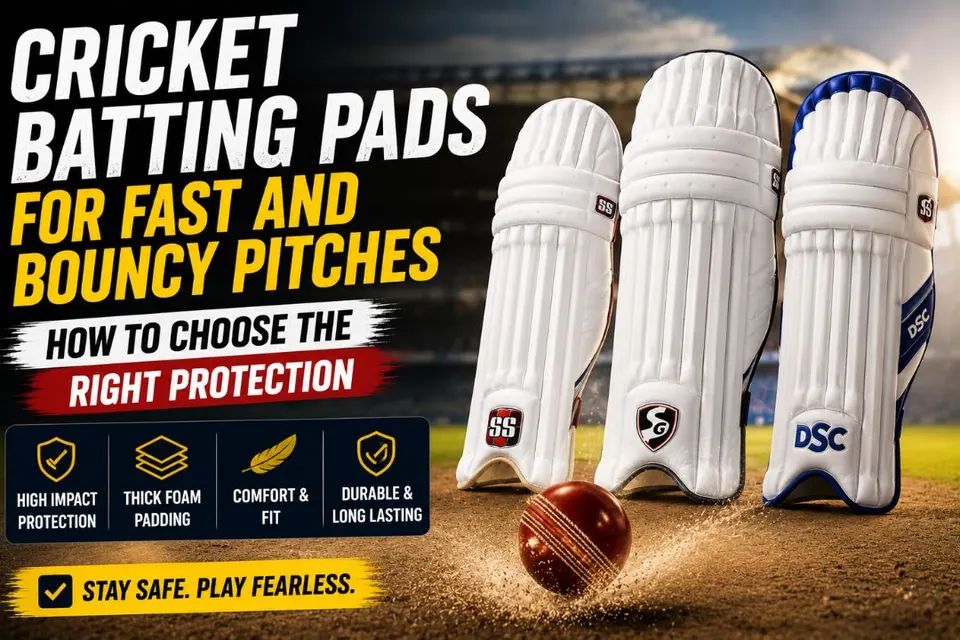
Not all cricket pitches in India play the same. A sea-level pitch in Mumbai in October plays very differently from a red-soil pitch in Delhi in November, and both differ from the hard, quick pitches of Punjab or Rajasthan in the early morning hours. For batters facing genuine pace on hard and bouncy surfaces, standard batting pads may not provide adequate protection in the critical zones — the knee, the top of the shin, and the thigh — where short-pitched deliveries frequently land. This guide is specifically for batters who play on quick, bouncy pitches and need batting pads that provide extra protection without restricting footwork.
On a slow or medium-paced pitch, most deliveries pitch in the good-length area and arrive at the batter's front pad at or below knee height. Standard padding on the face and knee roll of a conventional batting pad is adequate for these conditions.
On a fast and bouncy pitch, the ball consistently rises sharply from back-of-a-length. Deliveries targeting the body arrive at thigh height, hip height, and sometimes higher. Even a well-executed forward defensive exposes the top of the pad and the thigh pad zone to sharp, rising deliveries. The knee roll becomes less critical, and the top of the pad and thigh coverage zone becomes essential.
Standard pads protect from ankle to knee with full-density foam. For fast pitches, look for pads with full-density foam coverage extending above the knee roll — into the lower thigh area. This extended face protection is increasingly common in premium pad models.
On fast pitches where the ball rises sharply, a firmer and taller knee roll provides better protection for the knee joint during the front-foot defensive position. Look for a moulded cane-reinforced knee roll rather than a simple foam cylinder.
Heavier pads impede footwork — particularly the back-foot movement required to play short-pitched balls with confidence. On fast pitches, you must move quickly onto the back foot, get into position early, and play the pull or duck under the bouncer. Pads that are too heavy reduce the agility you need.
On fast pitches, you move more urgently between positions. Pads that shift during this movement create a safety hazard. Three-strap systems with secure velcro hold the pad in the correct position regardless of the amount of movement occurring between deliveries.
One of the best cricket pads for fast pitch conditions in India. Features reinforced moulded knee roll, extended foam coverage above the knee, and lightweight construction that does not compromise mobility. The three-strap system holds well during aggressive footwork and diving. Best for intermediate to advanced batters facing fast bowling on hard pitches. Price range: ₹2,500–₹4,500.
The top-end batting pad from SG — offers the most complete protection for hard and bouncy conditions. Used by state-level domestic cricketers, the Optipro has premium foam density throughout the face, a fully moulded cane-reinforced knee roll, and an extended upper pad that covers a higher thigh zone than standard models. Best for advanced and competitive cricketers on fast pitches. Price range: ₹4,000–₹7,000.
The SS Ton Pro series offers an extra-firm knee roll and a wider face than many comparable models — providing greater coverage width for batters facing sharp angled deliveries on fast surfaces. The Ton Pro 30 is the recommended model for fast pitch conditions. Best for club and competitive batters facing pace on hard surfaces. Price range: ₹2,000–₹4,500.
For club players who need improved fast-pitch protection without the premium price of SG Optipro or SS Ton Pro, the DSC Intense series offers reinforced knee roll construction and adequate foam density for leather ball club cricket on bouncy pitches. Best for intermediate club players. Price range: ₹1,200–₹2,500.
For full size guidance, measuring instructions, and a complete comparison of all brands across every price tier, see our cricket batting pads buying guide which covers standard pads in detail.
On fast pitches, batting pads alone are not enough. The thigh — particularly the front thigh — is one of the most frequently hit body parts against short-pitched fast bowling. Always pair your batting pads with a front thigh pad and an inner thigh guard. A chest guard and arm guard also become essential accessories against pace.
Our guide to must-have cricket accessories covers thigh pads, chest guards, and arm guards in detail — all of which work together with your batting pads as a complete fast-pitch protection system.
According to a study published by the British Journal of Sports Medicine, cricket batting injuries are most commonly to the lower limbs and hands, with leg injuries disproportionately occurring in batters facing fast bowling conditions — reinforcing the importance of high-quality, properly fitted batting pads on hard and bouncy pitches.
Browse the full range of cricket leg guards at SportsGear24x7, including all fast-pitch recommended models from SG, SS, and DSC.
• Get into position early — against fast bowlers on bouncy pitches, commit fully to either the front or back foot; hesitation leads to gloves or edges
• Watch the ball out of the hand — pace bowlers vary their length; train your eyes to pick up length from the bowler's hand, not when the ball pitches
• Use your pads confidently — against balls angled into the body, let the ball hit the front pad rather than playing at everything with the bat; your pads are there to protect you
Playing on fast and bouncy pitches demands batting pads with reinforced knee rolls, extended face coverage, lightweight construction, and a secure strap system. SG and SS offer the best fast-pitch batting pads for competitive cricketers, while DSC provides solid protection for club-level players on a budget.
Q1. What is the best batting pad for fast bowling in India?
The SG Optipro is the best batting pad for fast bowling conditions — premium foam density, cane-reinforced knee roll, and extended upper pad coverage. For club players, the SG Shield and SS Ton Pro are excellent mid-range options.
Q2. Are heavier batting pads better for fast pitches?
No. Heavier pads restrict the quick back-foot movement essential on fast pitches. Look for pads with better foam density and coverage, not greater total weight. Lightweight construction with reinforced protection zones is the ideal combination.
Q3. Do I need extra protection beyond batting pads for fast bowling?
Yes. On fast pitches, always wear a front thigh pad, arm guard, and chest guard in addition to batting pads. These protect the zones that batting pads do not cover — the thigh, forearm, and chest.
Q4. What size batting pads do I need?
Sit with your knee at 90 degrees and measure from your kneecap to the top of your foot. This is your pad length. Size up if you are between measurements. Categories: Junior Small (up to 35 cm), Junior Large (35–40 cm), Adult Small (40–44 cm), Medium (44–47 cm), Large (47+ cm).
Q5. How do I prevent batting pads from slipping during play?
Use the three-strap system with all straps fully tightened and velcro pressed firmly before going out to bat. Pads that use only two straps, or leave the top strap loose, shift during footwork and reduce protection precisely when you need it most.
The SportsGear24x7 Editorial Team is a group of passionate cricket enthusiasts and equipment specialists based in New Delhi, India. With over a decade of experience in the cricket gear industry, our team has helped thousands of players — from beginners to state-level competitors — find the right equipment for their game. Every article we publish is backed by real product knowledge, on-ground player feedback, and deep understanding of the Indian cricket ecosystem.