
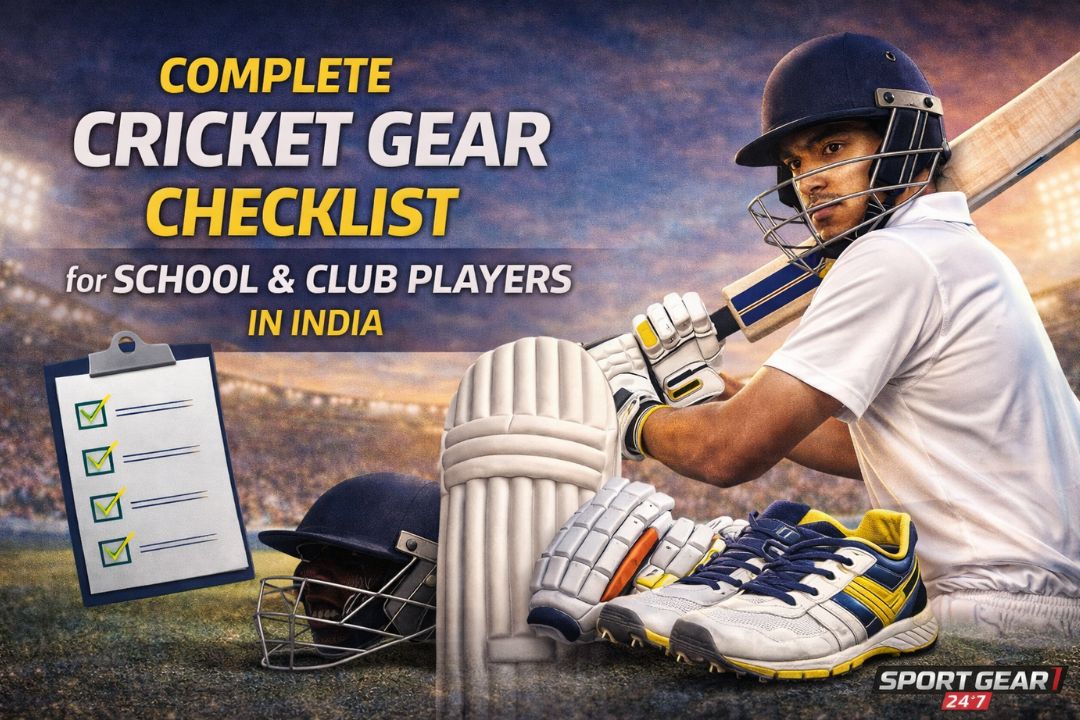
Complete Cricket Gear Checklist for School & Club Players in India
6 min read
On this page
Whether you are joining your school cricket team for the first time or stepping up to club-level cricket, one question always comes first: what gear do I actually need?
Not every player needs the same equipment. A school-level beginner and a competitive club cricketer have different gear requirements and buying the wrong things at the wrong time wastes money and can leave you under-protected on the field.
This complete cricket gear checklist for India's school and club players covers every item you need, explains why each one matters, and helps you prioritise your spending at every stage of the game.
Why a Proper Cricket Gear Checklist Matters
Cricket is one of the few sports where protective equipment is genuinely essential — not optional. A leather ball delivered by a fast bowler travels at significant pace, and without the right protective gear, the risk of serious injury is real.
The Board of Control for Cricket in India (BCCI) mandates the use of helmets and protective equipment at all organised levels of the game in India, including school and district competitions. Getting your checklist right means you play with confidence, safety, and comfort at every level.
THE COMPLETE CRICKET GEAR CHECKLIST
BATTING EQUIPMENT
1. Cricket Bat
The most personal item in your kit is your bat should match your age, height, playing level, and batting style.
- School players (under 13): Size 4 or Size 5
- Teenagers (13–15 years): Size 5 or Size 6
- Adults and senior club players: Short Handle (SH)
- Kashmir Willow for beginners; English Willow for club players and above
Browse the complete cricket bats collection at SportsGear24x7. For help choosing, read our guide on How to Select a Cricket Bat Based on Your Batting Position.
2. Batting Pads (Leg Guards)
Essential protection for the shins, knees, and thighs. Club players should look for pads with a high-density knee roll and strapping system that does not slip mid-innings.
Shop leg guards for all ages at SportsGear24x7.
3. Batting Gloves
Protect your hands and improve bat-grip control. Junior gloves and adult gloves are sized differently — always check the sizing guide before purchasing.
Explore our cricket gloves range covering junior, youth, and adult options.
4. Cricket Helmet
Non-negotiable at every level. Your helmet must be certified to the BS:7928-2013 standard — the safety benchmark used across all organised cricket in India and internationally.
Browse certified cricket helmets at SportsGear24x7.
5. Abdominal Guard (Box)
Mandatory for all male players. Available in junior and adult sizes and should always be worn when facing any type of bowling.
6. Thigh Pad and Inner Thigh Pad
Recommended for club-level players facing leather ball bowling regularly. Protects the upper leg from rising deliveries.
BOWLING EQUIPMENT
7. Bowling Spikes / Cricket Shoes
Fast bowlers especially need proper cricket shoes — the landing foot takes enormous stress during delivery, and the wrong footwear increases the risk of knee and ankle injuries.
School players on turf pitches need rubber-soled shoes. Club players on hard or grass pitches should invest in proper spiked cricket shoes.
Shop cricket shoes for turf, hard ground, and grass pitches at SportsGear24x7.
WICKET-KEEPING EQUIPMENT
8. Wicket-Keeping Gloves
Keeping gloves are completely different from batting gloves — they have a webbed catching area and a different padding structure. A player who keeps wickets needs a dedicated pair.
9. Wicket-Keeping Pads
Keeping pads are narrower and lighter than batting pads to allow squatting movement and lateral footwork behind the stumps.
FIELDING & TRAINING ACCESSORIES
10. Cricket Whites / Playing Clothing
For formal school and club matches, white cricket trousers and a collared shirt are generally required. Training sessions allow coloured kit.
Explore cricket clothing and accessories at SportsGear24x7.
11. Bat Grip and Grip Cone
Club players should carry a spare grip and grip cone in their kit bag — grips wear down over a season and should be replaced regularly.
12. Bat Mallet (for English Willow bats)
If you are playing with an English Willow bat, you need a bat mallet for the knocking-in process before match use.
KIT MANAGEMENT
13. Cricket Kit Bag
Your kit bag keeps everything organised, protected, and portable. Club-level players should invest in a wheelie or full-size duffle bag with a dedicated bat sleeve and separate ventilated compartment.
Explore our cricket kit bags range at SportsGear24x7.
14. Bat Cover
Protects your bat from moisture and impacts during transport.
15. Helmet Carry Case
Prevents grille damage and keeps your helmet padded and safe between matches.
Priority Buying Order: Where to Start
If you are building your kit from scratch, buy in this order:
- Helmet — safety first, always
- Bat — core performance item
- Pads and Gloves — essential protection
- Abdominal guard — mandatory for male players
- Cricket shoes — especially for bowlers
- Kit bag — to store and transport everything
- Accessories — grips, mallet, clothing as needed
For a complete starter bundle, explore our cricket kits — the fastest way to get fully equipped in one purchase.
Also read: Top 10 Mistakes Beginners Make When Buying Cricket Equipment before finalising your purchase.
Frequently asked questions
What is the minimum cricket gear a school player needs in India?
At minimum, a school cricket player in India needs a cricket bat, leg guards, batting gloves, a BS:7928-2013 certified helmet, and an abdominal guard. Cricket shoes are also strongly recommended for net sessions and match play on hard ground.
Do club cricket players need different gear than school players?
Yes — club cricket players generally face faster bowling, harder pitches, and more competitive match conditions. They need higher-quality protective gear (thicker pads, reinforced gloves), English Willow bats, proper spiked cricket shoes, and often additional protection like thigh pads and arm guards.
What size cricket bat does a 14-year-old need?
Most 14-year-olds use a Size 6 or Harrow-sized cricket bat, depending on their height. A Size 6 suits players up to approximately 5ft 3in (160cm), while a Harrow size fits those between 5ft 3in and 5ft 6in (160–168cm). Always measure the player's height before selecting a bat size.
How often should cricket gear be replaced?
Cricket bat grips should be replaced every 3–6 months of regular play. Batting pads and gloves typically last 2–4 seasons with proper care. Helmets should be replaced immediately after any significant impact, or every 5 years even without damage. Cricket shoes last 1–2 seasons depending on usage frequency and surface conditions.
Can a cricket kit be shared between two players?
Bats, kit bags, and clothing can be shared between players of the same size. However, helmets, gloves, and abdominal guards should never be shared — these are personal protective items that are fitted to individual measurements and can carry hygiene risks if shared.