Boxing Footwork Drills: The Training Habits That Actually Improve Your Punching Power
4 min read


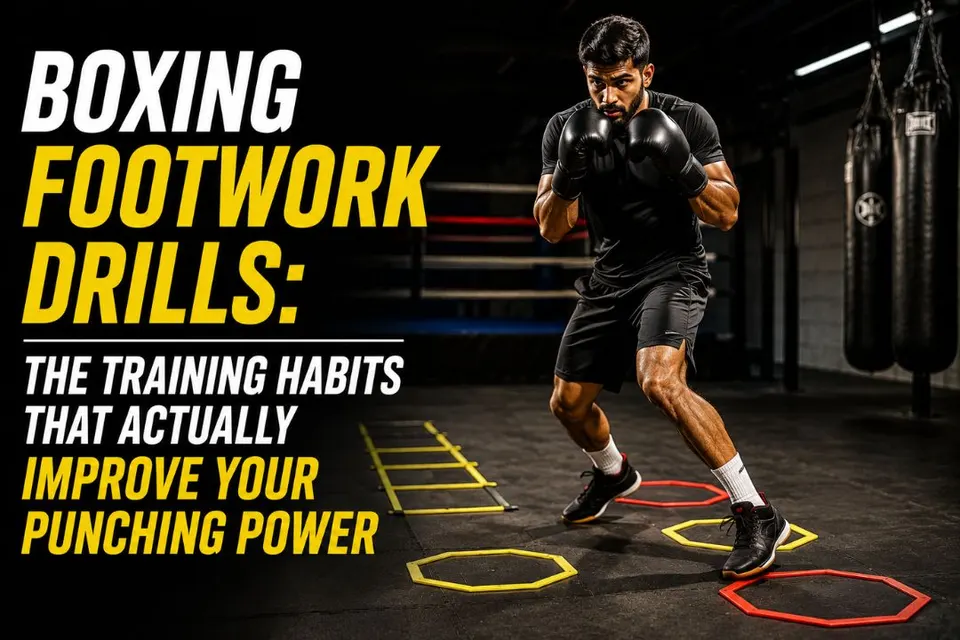
New boxers almost always focus on their hands — glove selection, wrap technique, punching combinations — while footwork gets treated as an afterthought. That’s backwards. Punching power, defensive positioning, and stamina management all originate in the feet, not the fists. This guide covers the footwork fundamentals and drills that actually move the needle for boxers at any level.
A punch thrown purely from the arm and shoulder, without proper foot positioning and hip rotation, generates a fraction of the power a properly grounded punch delivers — and it exhausts a boxer far faster, since the arm is doing work the legs and core should be sharing. Poor footwork also leaves a boxer flat-footed and slow to react defensively, increasing the chance of taking an unnecessary hit.
Before any drill work, stance matters. A balanced boxing stance — weight distributed to allow quick movement in any direction, knees slightly bent, feet roughly shoulder-width apart — is what every effective footwork pattern is built on. Boxers who stand too upright or too wide-legged sacrifice both mobility and punching power.
1. Shadowboxing with deliberate foot movement. Rather than just throwing punches in place, shadowbox while consciously stepping, pivoting, and repositioning — this builds the habit of moving with purpose rather than standing flat-footed while punching.
2. Ladder drills adapted for boxing. Agility ladder patterns build the fast, controlled foot speed that translates directly into quicker positional changes during exchanges.
3. Pivot drills. Practising a clean pivot off the lead or rear foot builds the rotational base that generates real punching power, since power comes from hip and core rotation transmitted through a stable foot plant, not from the arm alone.
4. In-and-out footwork drills. Practising controlled steps in to strike and immediately out to a safe distance builds the rhythm that underpins both offensive combinations and defensive positioning.
5. Rope skipping. A boxing staple for good reason — skipping builds the light, quick foot rhythm and cardiovascular base that carries a boxer through multiple rounds without footwork breaking down from fatigue.
Power in boxing is generated through a kinetic chain: ground contact through the feet, rotation through the hips and core, and transfer through the shoulder into the punch. A boxer with poor foot positioning breaks this chain at its foundation, meaning even a technically sound arm motion delivers only a fraction of available power. This is why coaches consistently emphasise footwork before combination work — the combinations only become effective once the base supporting them is sound.
• Warm up with light rope skipping to activate foot speed and rhythm before moving into more technical drill work.
• Isolate footwork from punching initially. Practising movement patterns without throwing punches lets a boxer focus entirely on foot positioning before adding the complexity of combinations on top.
• Progress to combined footwork-and-punch drills once individual movement patterns feel natural, integrating pivots and steps directly into combination work.
• Finish with shadowboxing rounds that deliberately incorporate everything practised earlier in the session — this is where isolated drill work gets tested under simulated combination pressure.
• Crossing the feet during lateral movement, which leaves a boxer badly off-balance and vulnerable to being caught mid-step.
• Standing too flat-footed, sacrificing the ability to react quickly in any direction.
• Failing to reset stance after a combination, leaving the next exchange starting from an unbalanced position.
• Neglecting rear-foot pivot when punching, which significantly reduces power transfer through the hips.
Training Focus | What Helps |
Foot speed and coordination | Rope skipping, ladder-style drills |
Balance and stance stability | Shadowboxing with deliberate positioning |
Punching power development | Pivot drills integrated with combination work |
Match/sparring conditioning | Combined footwork-and-punch rounds under fatigue |
Footwork is the unglamorous foundation that makes every other boxing skill work — punching power, defensive positioning, and stamina management all trace back to how well a boxer moves their feet. Dedicating consistent, isolated practice time to footwork, rather than treating it as something that develops automatically alongside punching, is one of the highest-leverage habits any boxer at any level can build.
Q: How much of boxing training time should go to footwork specifically?
Many coaches recommend a meaningful portion of early training — some even suggest footwork should be mastered before heavy combination or bag work begins, since it’s the foundation everything else builds on.
Q: Does footwork really affect punching power that much?
Yes — power is generated through a kinetic chain starting at the feet and transferred through hip rotation. Poor foot positioning breaks that chain and significantly reduces the power an otherwise technically sound punch can generate.
Q: Can I improve footwork without a coach?
Solo shadowboxing with deliberate attention to foot positioning, combined with rope skipping and ladder-style drills, can build meaningful footwork improvement, though periodic feedback from a coach helps correct habits that are hard to self-assess.
Q: Is rope skipping really that important for boxing footwork?
Yes — it’s a training staple specifically because it builds the light, quick foot rhythm and cardiovascular endurance that keeps footwork sharp deep into a training session or bout, rather than breaking down under fatigue.
The SportsGear24x7 Editorial Team is a group of passionate cricket enthusiasts and equipment specialists based in New Delhi, India. With over a decade of experience in the cricket gear industry, our team has helped thousands of players — from beginners to state-level competitors — find the right equipment for their game. Every article we publish is backed by real product knowledge, on-ground player feedback, and deep understanding of the Indian cricket ecosystem.