Badminton Racket Weight Guide: 3U vs 4U vs 5U — What Does It Mean and Which Should You Choose?
Updated 6 min read


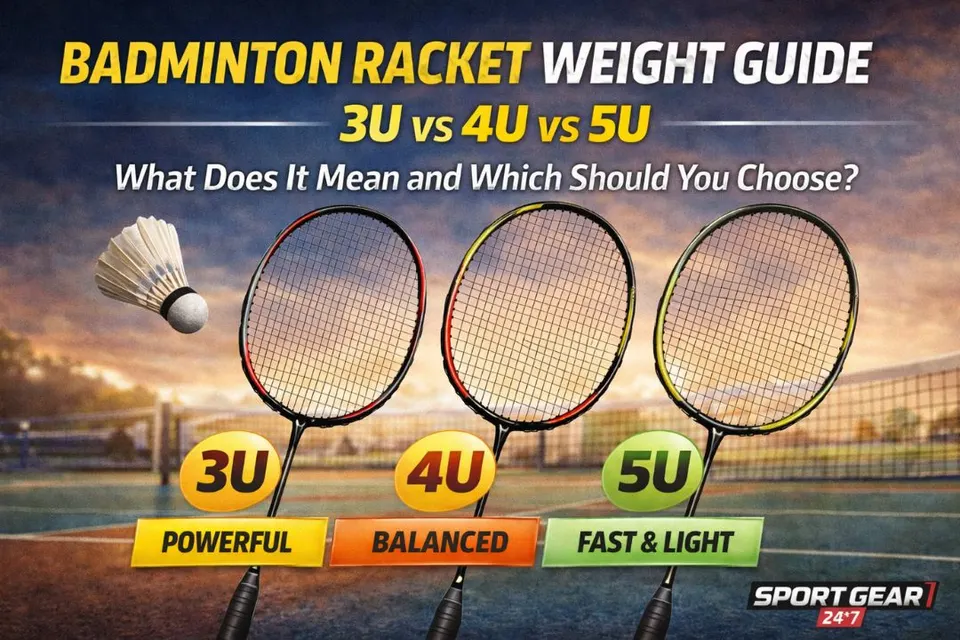
Walk into any sports store in India and pick up a badminton racket. Somewhere on the shaft or frame, you will find a code: 3U, 4U, or 5U. Most beginners ignore it completely. Most intermediate players guess at it. Almost nobody fully understands what it means — and how much it affects their game.
This guide changes that. By the end, you will know exactly what 3U, 4U, and 5U mean on a badminton racket, how racket weight shapes your playing style, and precisely which weight you should choose at your skill level.
The U-rating on a badminton racket refers to its weight category. The Badminton World Federation's equipment guidelines classify racket weights using this system — widely adopted by all major brands including Yonex, Victor, Li-Ning, and Wilson.
According to the Badminton World Federation, here is the standard weight classification:
Weight Code | Weight Range | Feel |
|---|---|---|
1U | 95–99.9g | Very Heavy |
2U | 90–94.9g | Heavy |
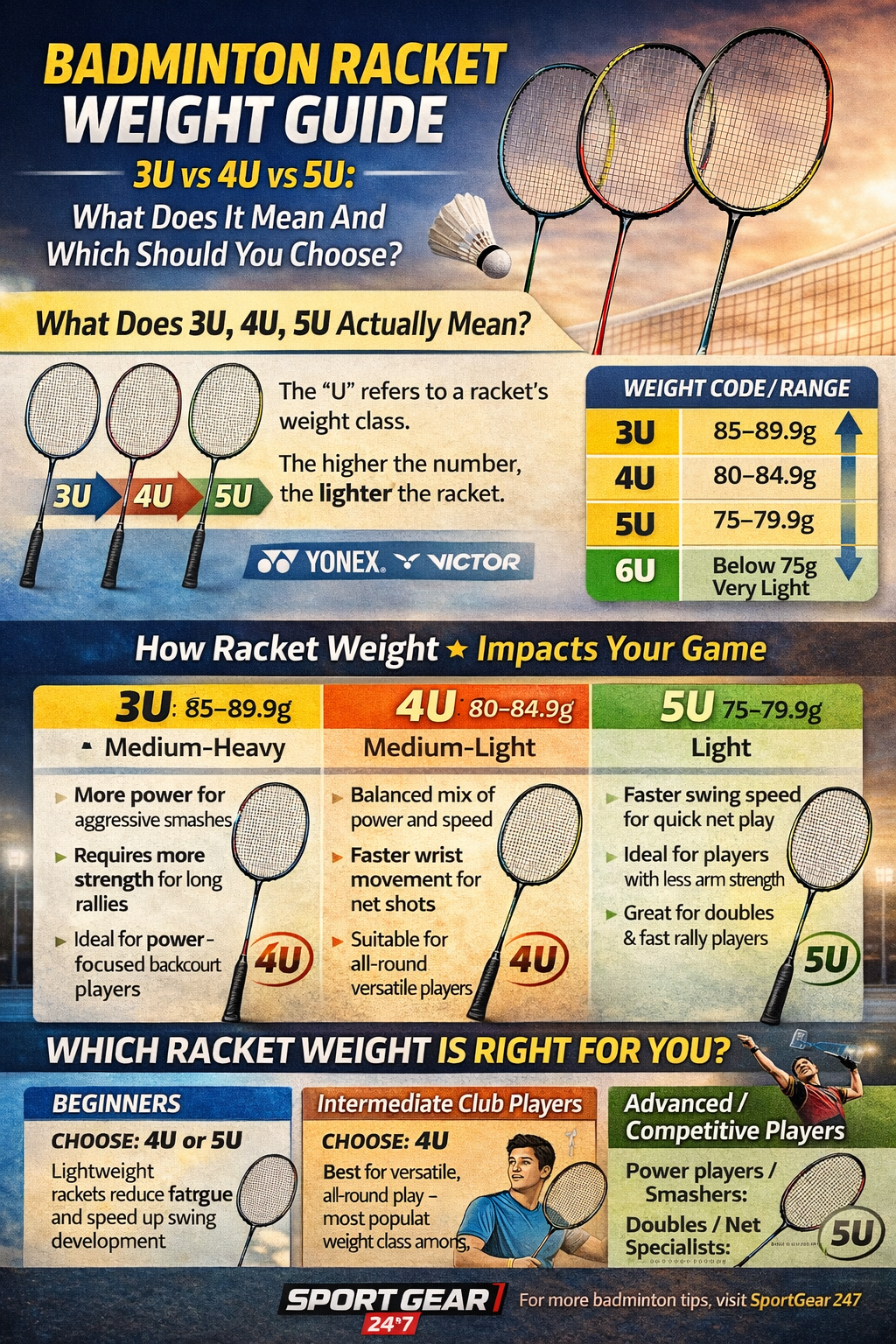
3U | 85–89.9g | Medium-Heavy |
4U | 80–84.9g | Medium-Light |
5U | 75–79.9g | Light |
6U | Below 75g | Very Light |
The lower the U number, the heavier the racket. The higher the U number, the lighter the racket. Most rackets sold in India fall in the 3U, 4U, and 5U range — which is why these are the three categories every Indian player needs to understand.
Racket weight is not just a comfort preference — it directly determines what shots you can play most effectively and at what physical cost.
Heavier rackets (3U — 85–89.9g):
Generate more power and momentum through the swing arc
Produce harder smashes with less technical effort
Slower to recover between shots — not ideal for quick net play
Require stronger arm and wrist muscles to sustain through long rallies
Better suited to aggressive, smash-dominant back-court players
Medium-light rackets (4U — 80–84.9g):
The best balance point between power and manoeuvrability
Suitable for all-round players who attack and defend across the full court
Fast enough for quick net exchanges, heavy enough for solid smashes
The most popular U-rating among Indian club and academy players
Recommended for intermediate players developing a defined style
Light rackets (5U — 75–79.9g):
Extremely fast racket head speed — ideal for quick net exchanges and deceptive shots
Less physical strain — great for players with shoulder or elbow issues
Less natural smash power — require better technique to hit through the shuttle
Excellent for net players, doubles specialists, and players who rely on touch and placement
Popular with women players and younger players building arm strength
Beginners
Choose: 4U or 5U
New players should prioritise a lighter racket. A 5U racket reduces arm fatigue during long practice sessions, allows faster swing development, and makes it easier to work on technique without fighting the weight of the racket. A 4U is also a strong choice if you want slightly more power without going too heavy.
Explore beginner-friendly badminton rackets and equipment at SportsGear24x7.
Intermediate Club Players
Choose: 4U
The 4U is the gold standard for club-level badminton in India. It gives you enough mass for a penetrating smash while keeping the racket fast enough for rally exchanges, net drops, and quick defensive retrievals. Most coaches in India recommend a 4U for players serious about improving their game.
Advanced and Competitive Players
Choose: Based on Playing Style
Power players / Smashers: 3U — maximises momentum for aggressive attacking play
All-court players: 4U — maintains versatility across the full court
Net specialists / Doubles: 5U — maximises speed and racket manoeuvring at the net
You will also see a G-rating on rackets — G4, G5, G6. This refers to grip size (G4 = largest, G6 = smallest). Most Indian adult players use G5. Junior players and players with smaller hands should use G6. Never buy a racket with a grip too large — it forces incorrect holding technique.
For detailed guidance on choosing the right grip, read How to Choose the Right Badminton Grip and How to Select the Right Badminton Grip for Comfort and Performance.
Racket weight and string tension work together. A heavier 3U racket with high string tension gives experienced players maximum power and control. A lighter 5U racket with lower tension is more forgiving and suited to developing players.
For complete guidance on string tension, read: Badminton Racket String Tension Explained: What's Best for Power & Control?
Browse our curated badminton equipment collection at SportsGear24x7 — featuring rackets across 3U, 4U, and 5U weight categories from Yonex, Victor, Li-Ning, and Wilson. Also read our buying guide: Top 5 Badminton Rackets Under ₹4000 for Beginners in India to find the right racket at the right budget.
Q1. What does 3U, 4U, 5U mean on a badminton racket?
3U, 4U, and 5U are weight classifications for badminton rackets. A 3U racket weighs between 85–89.9 grams, a 4U weighs 80–84.9 grams, and a 5U weighs 75–79.9 grams. The higher the U number, the lighter the racket. This weight directly affects how powerful, fast, and comfortable the racket feels during play.
Q2. Which is better — 3U or 4U badminton racket for beginners?
A 4U racket is generally better for beginners in India. It strikes the right balance between power and control without the physical demand of a heavier 3U racket. Beginners benefit from the lighter swing weight of a 4U, which reduces arm fatigue and allows more focus on developing correct technique. Very new players or juniors can consider a 5U for even less strain.
Q3. Which badminton racket weight is best for smashing?
For powerful smashing, a 3U racket (85–89.9g) is the best choice. The heavier mass creates more momentum through the swing, producing harder smashes with less technical effort. However, 3U rackets require stronger arm muscles and a more developed technique — they are not recommended for beginners or players still developing their game.
Q4. Is a heavier or lighter badminton racket better for doubles?
A lighter racket (5U) is generally preferred in doubles play, particularly for players positioned at the net. In doubles, quick reflexes, fast racket recovery, and net accuracy are more important than raw power. A 5U racket allows faster exchanges and faster hand speed at the net — key advantages in doubles pickleball [sic - badminton] strategy.
Q5. What badminton racket weight do professional Indian players use?
Most professional Indian badminton players — including those competing at national and international levels — use 3U or 4U rackets depending on their playing style. Power-oriented players like smash-dominant men's singles players typically use 3U rackets. All-round players and women's players more commonly use 4U. Players like PV Sindhu, known for her aggressive attacking game, have been associated with rackets in the 3U-4U range.
The SportsGear24x7 Editorial Team is a group of passionate cricket enthusiasts and equipment specialists based in New Delhi, India. With over a decade of experience in the cricket gear industry, our team has helped thousands of players — from beginners to state-level competitors — find the right equipment for their game. Every article we publish is backed by real product knowledge, on-ground player feedback, and deep understanding of the Indian cricket ecosystem.